Is this FTC complaint the reason why Forever Living closed down their US MLM business?

Recently we published an article revealing that Forever Living products is closing the MLM arm of its business in the USA.
Given how much, according to an MLM expert, companies like Forever Living Products rely on the purchases of their products by their own reps, this is shocking news. And as we speculated, unlikely to be a decision made willingly by the company.
And it looks like we were right. As reported by Behind MLM, it appears their hand was probably forced by an injunction by the Federal Trade Commission (FTC). Let’s look at what evidence the FTC provided in their complaint, and the details of the stipulated order for permanent injunction and other relief they issued to Forever Living.
Forever Living ‘knew most FBOs received no income’
On 14 April 2026, the FTC published details of an order to prohibit Forever Living and its operators from deceiving consumers about potential earnings.
Their complaint accuses Forever Living Products International LLC, its CEO Gregg Maughan, and its President Aidan O’Hare, as well as Forever Living.com LLC of using “deceptive earnings claims to attract new participants called Forever Business Owners (FBOs), most of whom made no money or even lost money”.
Christopher Mufarrige, Director of the FTC’s Bureau of Consumer Protection says that “Forever Living misled workers with promises of substantial income that, in reality, bore little to no resemblance to what participants actually earned”.
The FTC notes that, according to Forever Living company data, “in each of the last five years at least 77% of FBOs who purchased, sold or recruited during the year did not receive any compensation. Even after two full years as FBOs, more than 89% of new participants had not received enough income from Forever to recoup their initial $300-plus start-up cost”.
And they say that Forever Living were well aware of this: “Forever knew that nearly 90% of FBOs had received no income from Forever, and it had no basis for suggesting they were not trying to make money”.
(This doesn’t stop them continuing to make what we believe are deceptive income claims in the UK.)
What the FTC has ordered Forever Living to do
As a result the FTC published their order, which stipulates that, in the USA, Forever Living must:
- Refrain from making earnings misrepresentations
- Provide written subitationation for any earnings claims made
- Email a notice to everyone who has bought from or joined the company since 1 January 2023
- Post a prominent link to the notice on their US website
- Educate and monitor the compliance of their staff and FBOs
- Acknowledge receipt of the order and email a copy to staff and FBOs for the next 10 years
- Submit a compliance report one year later
- Submit a compliance report after any changes , for the next 10 years
- Create and retain personnel, sales, compliance and complaints records for the next 10 years
- Submit additional compliance records within 14 days of being requested
It’s telling that Forever Living’s response to these stipulations appears to be to close down their US MLM arm. To us, it looks like their business is not viable with these restrictions. And given these ‘restrictions’ simply require them to act honestly, in our opinion, that’s a fairly damning indictment on the MLM business model as a whole, and their business in particular.
The FTC provides examples of ‘deceptive earnings claims’
So why have the FTC taken action against Forever Living? For years we, and many other people, have been critical of MLMs using promises of easy income to recruit, when research published on the FTC website shows that an average of 99.6% of people who join an MLM will lose money after deducting business expenses.
And it looks like the FTC agree. In their complaint for the injunction, they detail some of what they believe are deceptive earnings claims made by Forever Living.
For example, they highlight a a video called “Setting Goals” that features multiple depictions of giant checks, as well as other earnings claims. The FTC note that this video was publicly available as recently as 20 May 2025. Here’s an example excerpt from their transcript and images taken from the FTC complaint document:

The FTC are critical of Forever Living’s giant cheques
They also note that, for many years, Forever Living has shared numerous images of FBOs holding giant checks, for FBOs to use in marketing the MLM opportunity:

The FTC say that Forever Living use the images of giant cheques because they influence consumers. After being warned in October 2021 regarding the use of deceptive earnings claims, the FTC claims that Aidan O’Hare emailed Forever Living executives, identifying the giant checks as a practice that might need to change, but stating:
“[i]n my opinion, this is not as simple as ‘not doing it anymore’. This is one of the biggest motivators we have and we need to tread carefully. The FBO’s love this and … I think we need to work together to strike a balance here ….”
According to the FTC, Forever Living were still publicly using images of the giant cheques on their mobile app as recently as October 2025. And were apparently providing materials featuring images of the giant cheques to their FBOs in September 2024.

Forever Living use their highest performing FBOs as role models
The FTC call out Forever Living for using their highest performing FBOs as role models, by “featuring them in trainings for new or aspiring FBOs, or otherwise promoting them”.
In one video, one of the “most successful FBOs in the history of Forever” apparently says:
“…most consumers will initially say “no” when offered the opportunity, but “when you can show them how easy it is, … everyone will say ‘okay, what you can do, I can do, and if I can earn a lot of money like you, of course I will do.”

The reality is that, according to their own data, most people who join Forever Living won’t make a profit, let alone achieve anywhere near the kind of success these top FBOs enjoy. As the FTC state:
“…contrary to Defendants’ representations that consumers are likely to make a profit as FBOs, Defendants’ data show that the vast majority of consumers pursuing the MLM opportunity incur expenses (indeed, Defendants encourage them to do so) but receive no income from Forever Living. In other words, these consumers lose money—the exact opposite of what Defendants advertise.”
The FTC also allege that, by promoting these prominent FBOs as role models, Forever Living, “direct other FBOs to be guided by their example, including their public use of misleading earnings claims, thereby providing those claims to consumers for use in recruiting”.
Further to this, our own research discovered that not all of the top FBOs paraded by Forever Living were quite as successful as they appeared. In this article we uncovered some of the lies and dark secrets top Forever Living managers are hiding. And we chart the downfall of some of Forever Living’s top UK FBOs here.
The FTC is critical of Forever Living’s recruitment messaging
The FTC is also critical of the messages Forever Living use when attempting to recruit, including their website. They refer to the use of terms such as:
- Unlimited earning potential
- Unlimited income
- A significant income stream [with] time freedom to build your life according to your dreams
- Build a full-time income
They also critique the company’s in-person gatherings, at which “Defendants repeat their deceptive earnings claims, and present FBO testimonials in which speakers discuss how Forever Living improved their lives, for instance, enabling them to rely solely on their FBO income.”
They point out that, “at no point were expenses associated with the MLM opportunity ever discussed, notwithstanding Forever Living’s data reflecting how most FBOs will not or are not likely to make any income”.
The company’s income disclosure statement (IDS) also comes across poorly under scrutiny. As the FTC states: “Defendants also have no basis for other claims they make in the First IDS relating to earnings, such as claims about who makes earnings and how.”
They even go as far as accusing Forever Living of attempting to, “severely inflate the percentage of FBOs in each purported income range”.
The FTC claim that most FBOs fail to recruit a profitable downline
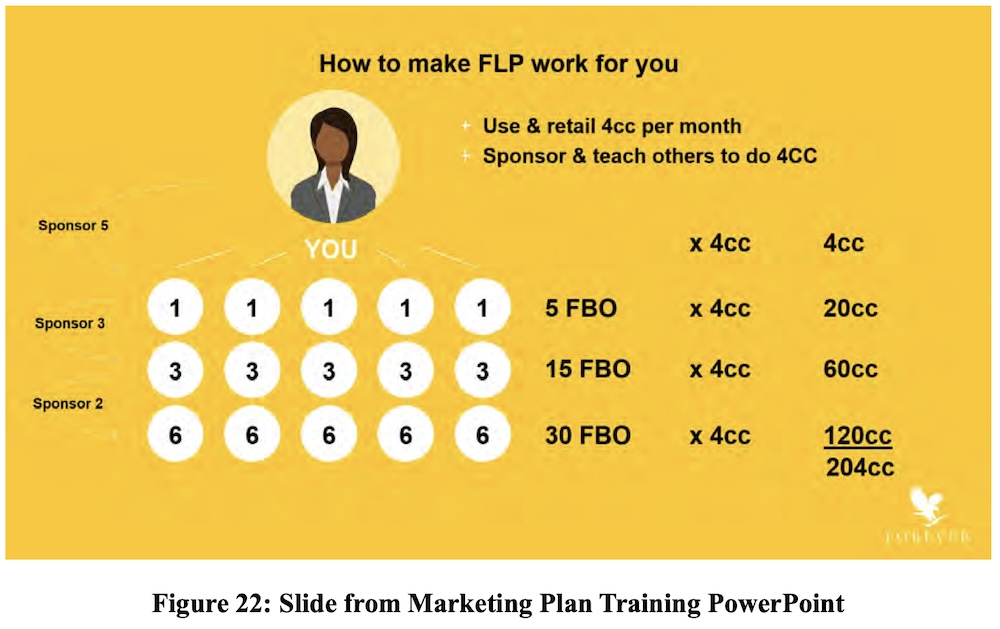
And finally, the FTC has an issue with Forever Living’s claims that FBOs can earn money by building a downline. They say that Forever Living, “represented, expressly or by implication, that consumers who become FBOs are likely to receive income based on purchases or sales made by members of their downline”.
However, as the FTC points out: “In reality, most FBOs do not succeed in recruiting a downline that generates income for them.”
Why we are pleased the FTC have taken action against Forever Living Products
There is far more detail in the 64-page document published by the FTC; we have shared just a small part of it here. We are pleased to see what we believe is the MLM lie laid bare by an organisation such as the FTC, and action being taken.
We hope that the FTC continues their work and extends it to other MLMs in the USA, and that other countries follow suit. A world in which no one can be seduced by false promises of easy riches can only be a better place.
Forever Living managers in the UK are STILL making income claims
We are disappointed to see that, since the FTC has taken action against Forever Living in the USA, FBOs in the UK have continued to make earning a living from Forever Living seem possible – and even easy – with income claims.
Here are social media posts published by some of the MLM company’s top UK managers – people they promote and use to present training – in the past few weeks. As you can see, they are even still using images of the giant cheques.