Streamlining air travel operations with smart technology

Key takeaways
- AI and IoT are transforming air transportation by improving operational efficiency and elevating passenger experiences, driving change at every stage of the air travel journey.
- Biometric and AI-powered solutions streamline critical processes such as boarding and baggage handling, reducing delays, lowering operational costs, and improving customer satisfaction.
- Investments in innovative technology are delivering both cost savings and environmental benefits across the industry, supporting the sustainability goals of airlines and airport operators worldwide.
Modern air travel is undergoing a rapid, unprecedented transformation, driven by the adoption of innovative technology spanning the entire spectrum of airport and airline operations. Today, innovations driven by artificial intelligence (AI) and the Internet of Things (IoT) are not only streamlining operational efficiency but also reshaping the overall passenger experience from curb to gate and beyond. Increasing demand for reliability, reduced delays, and enhanced safety is pushing aviation industry leaders to evolve rapidly.
As a result, advanced aviation flight operations software is now at the core of addressing these modern challenges. These technologies are creating a robust foundation for smoother journeys, fewer interruptions, and greater confidence for both airlines and travelers. As the aviation world becomes increasingly digitally connected, airports and airlines are leading the adoption of systems that anticipate operational bottlenecks and respond in real time, setting a dynamic new standard for air travel globally.
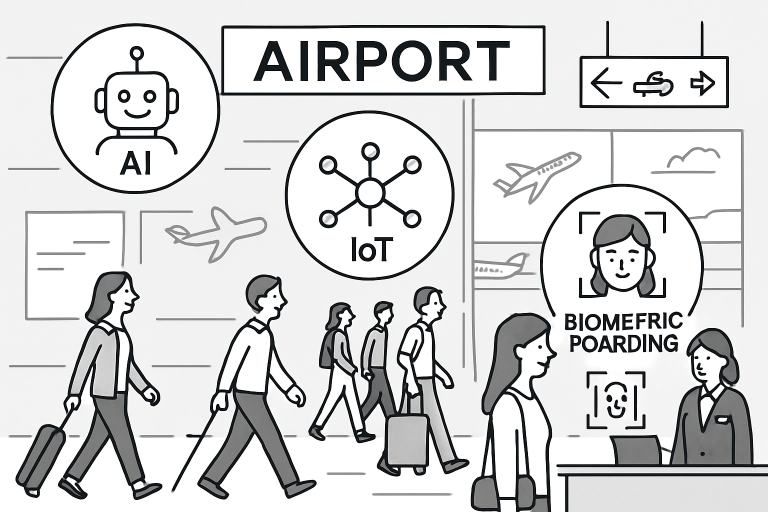
Travelers now seek seamless journeys and efficient safety protocols, driving a digital transformation across the industry through significant technology investments. Key enhancements include biometric identification, AI-driven baggage management, automated itinerary updates, and real-time monitoring, which streamline logistics and improve the travel experience. These innovations reduce stress for passengers and staff, boost airline efficiency, and enable personalized services at an unprecedented scale, creating a blend of high-touch service and low-friction travel.
Artificial intelligence in air traffic control
With global air traffic continually increasing, managing the safe and efficient movement of thousands of flights every day is more crucial and complex than ever before. To meet these challenges, airports are leveraging AI to equip air traffic controllers with advanced tools for real-time decision-making. For example, London Heathrow Airport implemented AIMEE, a pioneering AI system that tracks aircraft positions, runway activity, and other critical variables.
AIMEE delivers real-time visual insights to operators, enabling them to optimize aircraft routing, minimize taxi times, and prevent potential runway incursions before they occur. Such enhanced insight allows controllers to process and analyze vast amounts of data much more quickly than before, turning what used to be overwhelming into manageable, actionable information. This transformative capability is becoming indispensable, supporting controllers in their high-pressure roles and improving safety for everyone involved. As these AI technologies evolve and expand, they will play a central role in managing the rapidly growing flight volumes worldwide.
Biometric identification for seamless boarding
Lengthy queues and rigorous manual security checks have historically been among the most frustrating aspects of boarding at airport gates for travelers. However, the emergence of biometric identification technology, such as facial recognition and fingerprint scanning, is rapidly changing that narrative. Delta Air Lines became a pioneer in this space by launching an AI-integrated digital assistant within their mobile app, specifically designed to streamline the boarding experience.
Through this system, passengers receive step-by-step guidance and real-time alerts as they progress through the airport, making it easier to stay on schedule and locate their gates. More importantly, facial recognition technology is enabling accurate “touchless” identity verification, significantly reducing the need for physical documents while maintaining rigorous security standards.
These improvements lead to shorter boarding wait times, less congestion, and a safer environment, attributes that are especially valued in today’s health-conscious environment. By minimizing human error and enhancing privacy, biometric solutions are making air travel not only more convenient but also more secure for everyone involved.
AI-powered baggage management
The task of efficiently handling baggage remains one of the most operationally intensive areas within airports. Lost or mishandled luggage not only creates inconvenience for travelers but also increases costs and reduces trust in air services. To tackle this issue head-on, airports like Tokyo International are collaborating with tech leaders to implement AI-driven systems for baggage management.
Japan Airlines, in partnership with NEC Corporation, has rolled out a solution using advanced cameras and algorithms to instantly analyze the type, quantity, and size of carry-on bags at boarding gates. This system estimates the required space in overhead bins. It instantly alerts staff when capacity limits are reached, allowing them to proactively assist travelers or reroute baggage to checked holds before it becomes a problem.
Such proactive management minimizes last-minute gate delays, streamlines the boarding process, and ensures optimal use of storage space on board. Overall, these systems reduce the risk of damaged or lost luggage by maintaining accurate, real-time tracking and ensuring bags are handled efficiently from check-in to arrival.
IoT for real-time monitoring
The Internet of Things (IoT) is rapidly expanding the operational visibility airports have over their extensive, intricate environments. By strategically deploying sensors and connected devices throughout terminals, runways, baggage handling areas, and even airport vehicles, operators gain uninterrupted streams of real-time data. This data ranges from environmental factors, such as air quality and temperature control, to operational metrics, including equipment status and security monitoring.
Maintenance teams can use these insights to detect early warning signs of potential breakdowns, address climate-control or air-filtration issues, and minimize equipment downtime, all before disruptions affect passengers or flight schedules. IoT-driven dashboards also help airports optimize energy use by identifying waste and inefficiencies, contributing to both cost reduction and sustainability initiatives. As IoT networks become the backbone of airport operations, they continue to enable proactive, data-driven decision-making and a superior passenger experience.
Investments in digital transformation
The aviation industry’s commitment to digitalization has accelerated sharply in recent years, especially following the sweeping changes necessitated by the COVID-19 pandemic. Airlines and airports alike are dedicating unprecedented financial and strategic resources to transform their IT and operational infrastructures. According to SITA’s 2022 Air Transport IT Insights, digital technology investments saw a dramatic increase: airlines spent approximately $37 billion and airports $6.8 billion investing in new software and hardware solutions.
These investments are not confined to customer-facing areas; they also extend to maintenance, flight operations, safety management, and compliance tracking. As a result, the pace of new systems and service deployments is increasing rapidly, spurring a wave of innovation that is redefining what is possible in aviation. Industry experts anticipate continued growth in digital transformation spending well into the future, as operators seek to boost capacity, resilience, and customer service while reducing costs and environmental impacts.
Environmental benefits of smart technology
Beyond operational improvements, the adoption of innovative technologies is fueling the aviation industry’s transition toward more sustainable, eco-friendly practices. Programs such as the Next Generation Air Transportation System (NextGen) illustrate the potential for technology to drive environmental change at scale. NextGen leverages digital communications and satellite navigation to overhaul how aircraft are routed in U.S. airspace, reducing distances traveled, runway idle time, and unnecessary fuel consumption.
According to the Federal Aviation Administration, these improvements are estimated to save billions of gallons of fuel and prevent more than 650 million metric tons of carbon emissions from 2020 to 2040. The broader adoption of automated and optimized systems also supports ground-side environmental efforts, such as more intelligent energy management in airport facilities and more efficient transportation logistics. Collectively, these initiatives demonstrate that innovative technology is not only making aviation more efficient and safe but also a significant force for positive environmental stewardship.
Even more transformative changes are on the horizon
The comprehensive modernization of air travel operations with digital solutions marks a defining moment for the aviation sector’s evolution. Artificial intelligence in air traffic control, seamless biometric security measures, and real-time IoT monitoring are now integral elements of the modern travel experience.
Together, these advances offer a host of benefits: airports and airlines run smoothly, passengers enjoy safer, more comfortable journeys, and the industry as a whole moves closer to achieving ambitious sustainability goals. The ongoing wave of digital investment signals that even more transformative changes are on the horizon, promising air travel that continually improves, becomes more efficient, is more responsive, and is more environmentally responsible with every passing year.