
Innovative techniques for working with round jewellery making wire

Key takeaways
- Understanding the properties of round wire enhances design possibilities.
- Mastering basic techniques, such as loops and coils, is essential.
- Advanced methods such as wire weaving and hammering add texture and complexity.
- Proper tool selection and maintenance are crucial for quality craftsmanship.
Table of contents
- Understanding Round Wire
- Essential Tools for Wire Jewellery
- Basic Techniques
- Advanced Techniques
- Work Hardening and Finishing
- Common Mistakes and How to Avoid Them
- Inspirational Projects
- Conclusion
Round jewellery-making wire is a staple in crafting, serving as the foundation for a remarkable range of handcrafted pieces from dainty earrings to sculptural pendants. Whether you are a novice designer or an experienced artisan, learning to handle this versatile material unlocks creativity while ensuring the durability and beauty of your work. In particular, 14k gold wire for jewellery making provides exceptional flexibility and elegance, making it an excellent choice for everything from minimalist rings to statement necklaces.
Embracing the unique properties of round wire elevates not only the structure of your pieces but also their artistry. Through innovative methods and an understanding of their tools, makers can confidently design complex patterns, striking textures, and functional, wearable art.
From the significance of material selection to mastering intricate techniques, this guide explores innovative approaches that will help jewellers at any level achieve consistent, beautifully crafted results. Read on to discover how to choose the correct wire, select proper tools, execute essential techniques, and avoid common pitfalls in wire jewellery design.
For further reading on materials science and precious metals in jewellery, the Gemological Institute of America’s Jewelry Materials Guide is an authoritative resource to expand your understanding of wire choices and their properties.
Understanding round wire
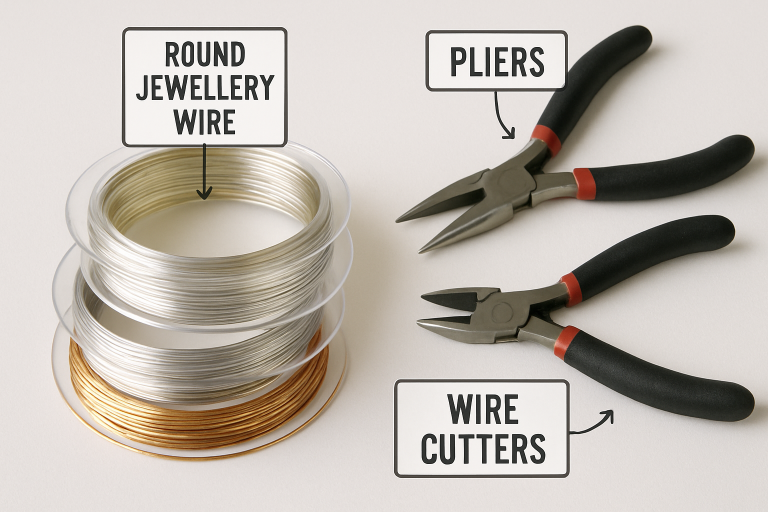
Round jewellery wire is defined by its uniform, circular cross-section. Available in gauges ranging from ultra-fine to substantial thickness, round wire is ideal for creating strong frames, delicate links, or statement embellishments. Primary wire materials include copper, brass, silver, and gold, each with unique working properties—soft gold being exceptionally pliable and easy to shape, while copper offers affordability and resilience.
Choosing the correct gauge and material is not just about aesthetics; it’s also about functionality. For example, heavier gauges offer structural support for cuffs or bangles, while finer wire is perfect for weaving or wrapping around stones. Understanding the hardness and malleability of your wire ensures the structural stability and long-term wearability of your creations. Additional information on wire gaugesand their applications can be found on Beading Diva’s Guide to Wire Gauges in Jewellery Making.
Essential tools for wire jewellery
High-quality, well-maintained tools are essential for professional, frustration-free results. Every wire artist should keep these key instruments on hand:
- Round-nose pliers: Crucial for forming consistent loops, curves, and circles.
- Chain-nose pliers: Ideal for gripping, bending ends, and closing jump rings without marring the wire’s surface.
- Flush cutters: Create smooth, flat wire ends to avoid sharp edges on finished pieces.
- Mandrels: Cylindrical tools used to form rings, hoops, and coils to exact sizes and shapes.
Good tool maintenance—such as regular cleaning and sharpening—prevents accidental scratches and prolongs the life of both your tools and your materials.
Basic techniques
Building foundational skills with basic techniques paves the way to more sophisticated designs and stronger, more uniform jewellery.
Creating Simple Loops
Loops are essential connectors for earrings, pendants, and linked chains. To create perfect loops:
- Grip the wire’s end with round-nose pliers.
- Rotate the pliers to bend the wire into a round loop.
- Rotate the loop so it’s flush against your project for security and a neat appearance.
Practice produces evenly sized loops—a signature of a skilled wire artist.
Making Wire Coils
Coils add beautiful dimension and can function as connectors or decorative accents. Crafting a well-formed coil involves:
- Anchoring the wire’s end and wrapping it snugly around a mandrel.
- Keeping each revolution tight and closely spaced.
- Trimming excess and compressing coils as needed to achieve a tidy finish.
Coils impart texture and interest to wirework, complementing both contemporary and classic jewelry designs.
Advanced techniques
After familiarizing yourself with the basics, introducing advanced techniques can lead to more complex, visually stunning creations.
Wire Weaving
Weaving uses fine-gauge wire to wrap or braid around a base, recreating textile-like patterns and intricate details. Consistency and patience enable experimentation with complex patterns, making them ideal for decorative bracelets and statement pendants. Mastery of wire weaving elevates any jeweller’s portfolio.
Hammering and Texturing
Adding hammered textures to wire thickens it and introduces attractive surfaces. Techniques include flattening wire with a chasing hammer and a steel block to achieve a dimpled effect, or using specialty hammers to create linear or stippled patterns. Experimentation brings out signature styles in your wire pieces.
Work hardening and finishing
Work hardening—or strengthening wire by manipulating it—ensures your jewellery keeps its shape and resists marring. Approaches include gently hammering, twisting, or repeatedly drawing the wire straight. Once hardened, use polishing cloths or rotary tools to buff out tool marks and enhance the wire’s natural sheen, giving your jewellery a professional shine.
Common mistakes and how to avoid them
Even skilled jewellers can make mistakes. Avoid the most frequent errors, such as:
- Overworking the wire: Frequent or excessive bending can cause wire fatigue and breakage. Plan your bends and handle each piece with intent to prolong lifespan.
- Inconsistent loops and coils: Marking your round-nose pliers with a fine-tip marker helps you create consistently sized loops and coils in each project.
- Neglecting tool maintenance: Dirty or damaged tools can mar wire surfaces and reduce precision. Clean, oil, and inspect your tools regularly to ensure they are in optimal condition.
Inspirational projects
Applying these techniques can inspire you to create standout pieces. Try your hand at:
- Wire-Wrapped Rings: Twist soft gold or silver wire around a gemstone for a one-of-a-kind ring.
- Weaved Bracelets: Combine simple and complex weaves with beads or gemstones for unique, textural interest.
- Textured Pendants: Hammer textures onto thicker wires to form sculptural focal pieces that stand out on any neckline.
Exploring diverse projects keeps your creativity fresh and your skills sharp.
Endless design possibilities
Mastering both fundamental and innovative techniques for working with round jewellery-making wire reveals endless design possibilities.
By focusing on the unique qualities of this essential material, choosing the right tools, and consistently practicing both foundational and advanced skills, you can create resilient, attractive jewellery that reflects your vision. Commitment to learning, tool care, and creativity will ensure your wire jewellery continually evolves.


