Top weight loss surgeons near Ken Caryl Colorado when GLP-1 coverage runs out

You open an insurance letter and feel your stomach drop: as of January 1, 2027, your weekly GLP-1 shots lose coverage. You’re not alone: many employers have dropped or limited coverage for GLP-1 drugs prescribed for weight loss alone.
What now? Regain isn’t inevitable, but you’ll need a new playbook. For many readers near Ken Caryl, Colorado, that means considering bariatric surgery—sometimes in tandem with medication.
This guide lines up seven surgeon-led programs within 25 miles. You’ll see which ones post real self-pay prices, accept Medicaid or Medicare, offer adolescent or reflux care, and where data gaps remain. You’ll also get an eight-question consult checklist and a plain-English look at Colorado’s 2027 obesity-treatment law.
Take a breath, grab a notepad, and let’s move from shock to strategy—together. Your next confident step starts now.
Before you dive into the options
Take a quiet minute to focus on your goals. A surgeon list helps only when you know what success looks like.
- Recall the wins GLP-1 therapy already gave you: steadier energy, looser jeans, better blood pressure.
- Note the results you most want to protect or improve over the next 12 months.
- Jot any worries about surgery, out-of-pocket cost, or long-term follow-up.
Need a refresher on how weekly injections and operations differ in durability, side effects, and lifetime cost? Skim our plain-language primer: GLP-1s vs. surgery considerations, then keep the tab open.
The questions this exercise sparks will guide every conversation, from an insurance appeal to your first consult with a bariatric team near Ken Caryl, Colorado. Ready to compare programs?
30-day action plan after coverage loss

Day 1–3: Keep taking your medication, under a clinician’s eye
Call or message the prescriber who writes your GLP-1. Explain the coverage change and ask for a bridge plan: dose adjustment, manufacturer coupon, or a medically supervised taper. Sudden stops can spike appetite and blood sugar.
Day 4–7: Pin down why the plan said “no”
Re-read the denial letter and copy the paragraph or code that ends coverage. Note both the date you received the letter and the date benefits stop. Those lines will anchor any appeal.
Week 2: Request the appeal roadmap in writing
Phone member services and ask, “What type of decision is this, and what are the exact steps and deadlines to appeal?” Federal rules give you at least 180 days to file an internal appeal, and the plan must describe any external-review option. Keep that written roadmap next to your denial letter.
Week 2–3: Build a documentation packet
Create a digital folder called “GLP-1 appeal” and add recent and baseline weights or BMIs, lab or imaging proof of comorbidities, pharmacy receipts showing every fill and dose change, certificates from lifestyle programs, and chart notes on any side effects. Thorough records move reviewers from emotion to evidence.
Week 3–4: Book one surgical information visit
A consult is a conversation, not a contract, yet wait lists often run three to eight weeks. Secure the earliest slot (virtual or in person), and ask whether the surgeon operates at an MBSAQIP-accredited hospital. Getting on the calendar now avoids a last-minute scramble, even if you ultimately stay on medication.
By day 30, you will have three assets: a safe medication plan, an evidence-backed appeal dossier, and a surgery consult date if you choose that path. Momentum beats paralysis every time.
Why surgery often follows GLP-1 therapy

Weight regain after stoppage is common
GLP-1 shots work only while they’re in your system. A 2026 meta-analysis found that about 60 percent of the weight lost during treatment returned within one year of stopping. That rebound reflects the same hormones that drove weight gain in the first place. Once pharmacologic appetite control fades, biology pushes back. Surgery changes gut anatomy and alters hormone signals in a longer-lasting way.
Real-world results widen the gap
Clinical trials dose patients on schedule and pair them with dietitians; daily life rarely does. In a 44,000-patient, two-health-system study, sleeve patients lost roughly 22 percent of starting weight at three years, while semaglutide users held 7 percent and tirzepatide users 10 percent at two years. Gastric bypass approached 28 percent. The longer a prescription lapses, the wider that gap grows.
Up-front cost vs. lifetime spend
A self-pay sleeve at Denver Health lists near $11,000 (surgeon, hospital, anesthesia). One retail year of semaglutide can top $16,000 before supplies or labs; three years can exceed $48,000, with no equity if coverage vanishes again. Surgery still requires vitamins, labs, and follow-up, but those predictable line items usually run a few hundred dollars a year, often billed as preventive care.
Medication and surgery can work together
This is not an either-or choice. Many programs start a GLP-1 before surgery to shrink the liver or restart it later if weight plateaus. Think of the drug as a volume dial and surgery as the amplifier; adjust the dial when needed, but let the amplifier carry the load. Coordination matters: your bariatric surgeon, primary-care clinician, and prescribing doctor should share lab results, dose timing, and insurance paperwork so you are never the go-between.
How we chose the seven local programs
We wanted a shortlist you can trust, not a popularity contest, so we applied six filters.
- Proximity. We mapped a 25-mile straight-line radius from Ken Caryl to keep drive times reasonable.
- Active bariatric practice. Each surgeon holds an unrestricted Colorado license (verified on the DORA database) and current hospital privileges for the procedures listed.
- Training and quality infrastructure. Fellowship training in metabolic or minimally invasive surgery was required. Centers with MBSAQIP accreditation, an American College of Surgeons quality program, scored highest.
- Documented support team. A dietitian, behavioral-health clinician, and a published long-term follow-up plan had to appear on the program site or be confirmed by staff.
- Patient experience and transparency. We counted reviews on independent platforms and favored programs that publish bundled self-pay prices or itemized surgeon plus hospital fees.
- Legal and safety screen. We searched Colorado court dockets and DORA board actions for recent malpractice verdicts or license restrictions; unresolved red flags placed a provider on hold.
The result is a curated set of options, each tagged “best for” a specific need. Use the list as a springboard, then vet every program with the consultation checklist that follows.
Compare your options at a glance
| Program (featured surgeon) | Best for | Distance (mi)* | Core procedures | MBSAQIP status† | Published self-pay price (USD)‡ | Medicaid / Medicare | Telehealth | Review snapshot§ | Biggest info gap |
| Bariatric & Metabolic Center of Colorado (Dr Joshua Long) | Up-front cash bundles; SADI-S; band revision | 15 (Greenwood Village office) | Sleeve, bypass, SADI-S, revisions | Yes (AdventHealth Parker, Comprehensive) | Sleeve $12,250; bypass $18,650; SADI-S $20,060 | Most major plans | Free education webinars | 2,000+ surgeries (Dr Long) | None; full self-pay price list online |
| Denver Health Bariatric Center (Drs Morton & Thomas) | Medicaid / Medicare; itemized prices | 12 | Sleeve, bypass | Yes | Sleeve $12,900; bypass $17,500 | Yes | Limited | 4.7 / 93 | Wait-time transparency |
| UCHealth Anschutz Surgical Weight Loss (Dr Akshay Chauhan) | Complex cases; adolescent program; endoscopy | 19 | Sleeve, bypass, BPD, band, endoscopic options | Yes (Comprehensive + Adolescent) | Not posted | Yes | Yes | 5.0 / 23 | Cash bundle |
| Intermountain Denver Midtown Weight Loss & Reflux (Drs Thompson & Raheb) | Reflux focus; high survey volume | 14 | Sleeve, bypass, SADI-S, revisions | Yes (Saint Joseph) | Estimate on request | Yes | Robust | 5.0 / 129 (Thompson) | Surgeon-level outcomes |
| Lutheran Weight Loss & Reflux Center (Dr Emily Speer Heffner) | Female surgeon; severe GERD | 13 | Sleeve, bypass, complex foregut | Pending | Not posted | Yes | Yes | 4.8 / 266 | Accreditation proof |
| HCA Denver Center at Rose (Drs Weaver & Irani) | Broad menu; Spanish-language care | 15 | Sleeve, bypass, duodenal switch, OAGB, revisions | Yes | Surgeon fee only—sleeve $4,500; bypass $6,000 | Select | Yes | 4.6 / 52 (Weaver) | Hospital & anesthesia fees extra |
| SurgOne / AdventHealth – Littleton (Dr Jesse Conner) | Closest consult commute | 1.5 | Sleeve, bypass | TBD | Not posted | Verify | Virtual | 5.0 / 3 | Annual volume; MBSAQIP |
*Straight-line distance from central Ken Caryl
†MBSAQIP = Metabolic and Bariatric Surgery Accreditation and Quality Improvement Program
‡Always request a written, itemized quote listing surgeon, assistant, hospital, anesthesia, labs, and follow-up
§Review counts combine independent platforms; fewer than ten reviews flag low reliability
Local option 1: Bariatric & Metabolic Center of Colorado (Dr Joshua Long)
Best for: Published self-pay bundles, SADI-S, and band revisions
Dr Joshua Long, MD, MBA, FACS, FASMBS, is double-board-certified in surgery and obesity medicine, has performed well over 2,000 surgeries, and has served as a national MBSAQIP site reviewer. The center stands out by posting all-inclusive cash prices online: robotic sleeve $12,250, robotic bypass $18,650, robotic loop duodenal switch (SADI-S) $20,060, LAP-BAND revisions from $13,750, and band removal at $5,400. Each covers pre-op care and education, surgery, anesthesia, the hospital stay, and 90 days of aftercare.
Beyond pricing, Dr Long performs the loop duodenal switch (SADI-S, a sleeve plus single-connection intestinal bypass) and complex band removals that other metro practices often refer out. This makes BMCC a match if prior devices failed or your insurer denies a higher-powered procedure.
Good to know:
Office: 5351 South Roslyn Street, Greenwood Village, about 15 miles from Ken Caryl.
Surgery takes place at AdventHealth Parker, an ASMBS comprehensive MBSAQIP center, where Dr Long is bariatric medical director.
BMCC accepts most major Colorado and national insurers, runs free education webinars and Denver support groups, and offers a 60-second online assessment.
Its own guide compares GLP-1 drugs and surgery: the medications work only while you keep taking them, while BMCC offers surgery for patients with a BMI over 40, or over 35 with obesity-related conditions.
If self-pay clarity and advanced revisions top your checklist, start here.
Local option 2: Denver Health Bariatric Surgery Center (Drs Alexander Morton & Sany Thomas)
Best for: Medicaid or Medicare coverage and line-item self-pay prices
Denver Health runs a safety-net program accredited as an MBSAQIP Comprehensive Center with adolescent capability. Dietitians, psychologists, and surgeons share one electronic chart, a plus when several conditions need coordination.
Transparent pricing. The website lists a sleeve package at $11,337 plus about $1,621 in mandatory pre-op testing; a bypass package is $15,920 plus the same add-ons. These numbers cover surgeon, hospital stay, anesthesia, and the first 90 days of follow-up.
Insurance access. Denver Health contracts with Colorado Medicaid, Medicare, and major commercial plans, and offers sliding-scale aid for those who qualify.
What to confirm when you call
Current wait time for nutrition classes and surgery dates
Whether follow-up beyond 90 days incurs separate copays
Virtual-visit availability if transportation is an issue
Surgeon-specific annual volumes and 30-day leak or readmission rates
If you need public-insurance acceptance or want every dollar spelled out before you sign, place Denver Health on your short list and book early to secure a spot.
Local option 3: UCHealth Anschutz Surgical Weight Loss Center (Dr Akshay Chauhan & team)
Best for: Complex medical histories, adolescent care, and access to bariatric endoscopy
UCHealth’s flagship campus in Aurora is Colorado’s only bariatric program with both an MBSAQIP Comprehensive designation and added credentials for adolescent and obesity-medicine care. Surgeons, gastroenterologists, endocrinologists, and pediatric specialists share one Epic chart, a plus if you juggle diabetes, severe reflux, or prior abdominal surgery.
What they offer
Standard operations: sleeve, Roux-en-Y bypass, and biliopancreatic diversion (BPD)
Revision and endoscopic tools: sleeve-to-bypass conversions, gastric outlet repair, and endoscopic sleeve gastroplasty when anatomy allows
Research access: active trials on GLP-1 use before surgery (ask the coordinator for openings)
What’s missing online
No public cash bundle. Staff quote prices only after reviewing imaging and labs, so request a written itemization early.
Questions to ask at your consult
Surgeon-specific annual volumes for your chosen procedure
Whether the hospital and each assisting clinician are in network for your plan
Wait time for required nutrition or psychology visits
Which endoscopic options are truly available now versus “coming soon”
You may face a longer drive and busier waiting rooms than at smaller centers, yet you gain academic depth and a safety net if complications arise.
Local option 4: Intermountain Denver Midtown Weight Loss & Reflux Center (Drs Kyle Thompson & John Raheb)
Best for: Reflux-focused care, strong patient-survey volume, and lifelong follow-up
Heartburn and obesity often appear together. Thompson and Raheb trained in advanced GI and flexible endoscopy, so they can repair a hiatal hernia or severe GERD during the same sleeve or bypass.
Patient feedback you can measure
Intermountain’s public portal shows Kyle Thompson at 5.0 from 129 ratings and John Raheb at 4.9 from 119 ratings. Large sample sizes soften the impact of any single rave or complaint and suggest consistent bedside manner.
Program structure
Operations offered: sleeve, Roux-en-Y bypass, and single-anastomosis duodeno-ileal bypass (SADI-S, a sleeve plus one intestinal bypass)
Accreditation: surgeries take place at MBSAQIP-certified Saint Joseph Hospital
Support: weekly telehealth check-ins, peer groups, and a promise of annual visits for life
Costs and questions
The center does not post a bundle price. Ask for a written estimate listing surgeon, hospital, anesthesia, and dietitian fees. Confirm which surgeon performs SADI-S and whether nutrition visits are included or billed separately.
If reflux shapes your daily life and you value data-backed patient experience, Denver Midtown belongs on your consult list.
Local option 5: Lutheran Weight Loss & Reflux Center (Dr Emily Speer Heffner)
Best for: A female surgeon and advanced reflux or foregut problems
Dr Emily Speer Heffner trained in minimally invasive and bariatric surgery at Providence Portland Medical Center and now concentrates on operations that address both weight and reflux. Her toolbox spans sleeve, gastric bypass, and foregut repairs such as large hiatal-hernia fixes or pyloroplasty for gastroparesis (delayed stomach emptying).
What the numbers say
Intermountain’s patient-survey portal shows 4.8 out of 5 from 266 ratings (32 written reviews). A sample this large points to steady patient satisfaction.
Accreditation check
Lutheran was previously MBSAQIP-accredited under SCL Health. As Intermountain finalizes the system merger, confirm whether the bariatric unit still carries the badge or is in active re-survey. The coordinator can provide the most recent certificate.
Questions to bring to your consult
Does Dr Heffner operate at Lutheran or another hospital, and is that site currently MBSAQIP-accredited?
Are dietitian and behavioral-health visits included in network or billed separately?
What is the center’s sleeve-to-bypass conversion policy if reflux worsens after a sleeve?
Request a written self-pay quote covering surgeon, hospital, anesthesia, assistant, and follow-up.
If you value a surgeon who understands reflux intricacies and prefer discussing sensitive topics with a woman, place Lutheran on your shortlist.
Local option 6: HCA Denver Center at Rose (Drs John Weaver & Katayun Irani)
Best for: Broad procedure choice, Spanish-language care, and telehealth convenience
Rose Medical Center’s bariatric unit offers the widest menu in this roundup: sleeve, Roux-en-Y bypass, classic and loop (one-anastomosis) duodenal switch, band removal, and robot-assisted single-incision approaches.
Cost snapshot
HCA posts the surgeon fee only: $4,500 for a sleeve and $6,000 for a bypass. Hospital, anesthesia, and assistant charges come separately, so we suggest asking for a full written bundle before you commit.
Patient feedback
John Weaver, MD: 4.6 / 52 reviews on Healthgrades
Katayun Irani, MD: 4.5 / 30 reviews on Healthgrades
Scores vary across platforms, so read recent comments and request the team’s 30-day leak and readmission data.
Access and language
Dr Irani conducts consults in English and Spanish, and most pre-op classes run via telehealth, helpful if commuting to central Denver is difficult.
Questions to confirm
Written, all-inclusive estimate covering surgeon, hospital, anesthesia, assistant, labs, and follow-up
Whether the surgical assistant is in your insurance network
Surgeon-specific annual volume for your chosen procedure
Post-op dietitian visits, bundled or billed separately
If you need advanced procedure options or bilingual care, place Rose on your shortlist and pin down every fee in writing first.
Local option 7: SurgOne / AdventHealth Littleton (Dr Jesse Conner)
Best for: The shortest commute from Ken Caryl and a no-nonsense first consult
Dr Jesse Conner completed a minimally invasive and bariatric-surgery fellowship at Houston Methodist Hospital and is board-certified in general surgery. His Littleton office sits just 1.5 miles from central Ken Caryl, making an after-work consult realistic.
What is clear
Core procedures: sleeve and Roux-en-Y bypass
Hospital affiliation: AdventHealth Littleton, which is pursuing MBSAQIP accreditation (status pending; ask for the latest certificate)
Telehealth: virtual follow-ups available for many visits
What to confirm
Written, all-inclusive self-pay quote covering surgeon, hospital, anesthesia, assistant, and labs
Annual sleeve and bypass volumes for Dr Conner
Dietitian and behavioral-health support—on site or by referral, and in network
Revision pathway if future weight regain occurs
Patient feedback is still limited: Healthgrades lists 5.0 from three ratings. Treat that small sample as a starting point, then compare its answers with data from at least one larger center.
How to compare surgery types after GLP-1 treatment
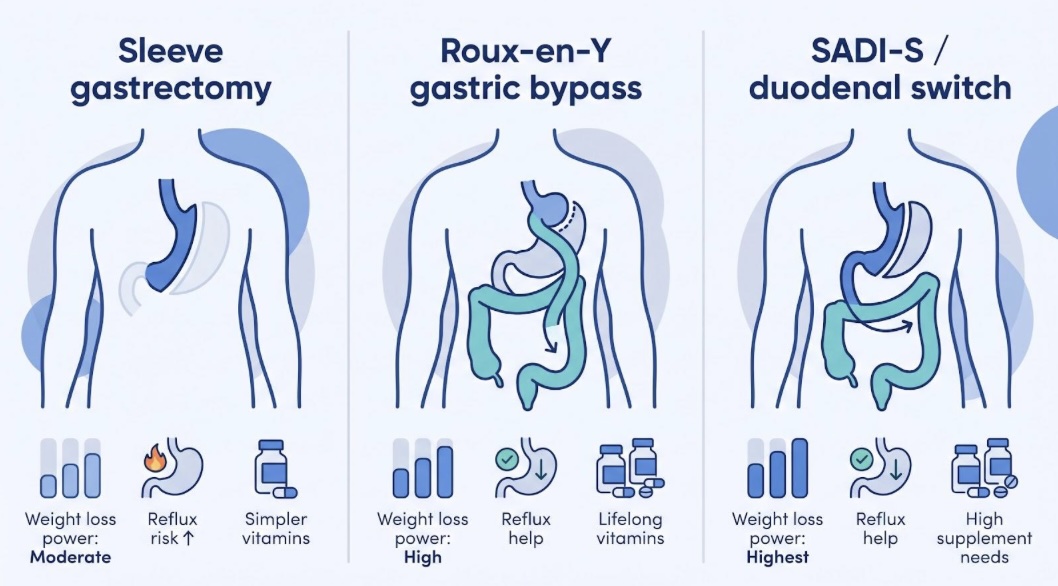
Three operations cover almost every case near Ken Caryl. Each balances weight-loss power with follow-up demands.
Sleeve gastrectomy: the simple workhorse
Surgeons remove roughly 80 percent of the stomach, leaving a narrow tube. Hunger hormones fall, meals shrink, and real-world weight loss averages 18–24 percent at three years.
Why it pairs well after GLP-1 therapy
- Adds metabolic punch without intestinal bypass, so vitamin monitoring stays simpler.
Watch-out: reflux can worsen; if you already take daily antacids, ask for an upper-GI study before choosing a sleeve.
Roux-en-Y gastric bypass: the metabolic multitasker
Food detours around the upper two feet of intestine, triggering bigger hormonal shifts and easing stubborn reflux. Average loss reaches 25–30 percent at three years, often with rapid diabetes improvement.
Trade-offs
Bypassed intestine means lifelong vitamins and a small risk of dumping syndrome after high-sugar meals. Hospital stay and price usually run a notch higher than a sleeve.
SADI-S / duodenal switch: the heavy hitter
A sleeve plus a single connection deeper in the intestine (single-anastomosis duodeno-ileal bypass). Studies show 30 percent or more total weight loss and high diabetes-remission rates, but protein and fat-soluble vitamin monitoring is strict.
When to consider
Very high starting BMI, insulin-dependent diabetes, or weight regain after a prior sleeve, provided you can commit to supplements and quarterly labs.
Bottom line:
Match each procedure to your health goals, reflux status, supplement discipline, and budget. Then ask each surgeon for their 30-day leak and readmission rates at your consult.
What surgery may really cost near Ken Caryl
Price tags can feel overwhelming, but guessing helps no one. Here is what the two centers that publish full bundles charge:
- Bariatric & Metabolic Center of Colorado: sleeve $12,250, bypass $18,650, SADI-S $20,060
- Denver Health: sleeve $11,337 plus about $1,621 in mandatory pre-op tests; bypass $15,920 plus the same add-ons
Why the spread? Private centers bundle surgeon, hospital, anesthesia, and assistant fees under one roof, while Denver Health lists required labs and imaging separately. Either way, the quote is all you owe unless a complication needs extra care.
Partial prices can mislead. HCA Rose lists a $4,500 surgeon fee for a sleeve, appealing until you add the hospital room, anesthesia, assistant, and supplies, which often brings the total in line with Denver Health or BMCC.
Hidden costs to budget for include dietitian or psychology visits your insurer may require, sleep studies or cardiology clearance when risk factors surface, vitamins and lab work after the 90-day honeymoon, and the rare leak test or ER visit outside any warranty window.
Smart next step: we suggest asking each program for a signed PDF estimate that lists every billable player—surgeon, assistant, hospital, anesthesia, labs, dietitian, and radiology—and saving it to the cloud. A clear paper trail is your best defense against surprise bills.
Colorado insurance checkpoints
Coverage depends on who regulates your plan. Begin with the plan type, then read the fine print.

Commercial employer plans
Open your summary of benefits and search for “bariatric surgery” and “weight-management exclusion.” A plan may cover surgery under major medical while excluding anti-obesity drugs, or the reverse. If the language is unclear, call member services and ask:
- “Is metabolic or bariatric surgery a covered benefit for the current plan year?”
- “Which hospitals and clinicians must be in network for the benefit to apply?”
Federal rules give you at least 180 days to file an internal appeal after any denial. We suggest saving all call notes and chat transcripts.
Individual and small-group ACA plans
Colorado already lists medically necessary bariatric surgery as an essential health benefit in the individual and small-group benchmark. If you buy coverage on Connect for Health Colorado, surgery should be available once clinical criteria are met.
Health First Colorado (Medicaid)
State Medicaid pays for bariatric surgery with prior authorization but generally excludes drugs used solely for weight loss. Exceptions apply if the drug treats another FDA-approved indication such as cardiovascular risk reduction.
State-regulated plans: Colorado’s 2027 mandate changes the game
Colorado Senate Bill 25-048 requires state-regulated large-group plans renewing on or after January 1, 2027 to cover bariatric surgery, medical nutrition therapy, and intensive lifestyle treatment. The same law obliges carriers only to offer, not automatically include, coverage for FDA-approved anti-obesity medications. Ask HR whether your plan is state-regulated or self-funded under ERISA; the mandate does not reach self-funded plans. If the plan renews before the deadline, set a reminder to check coverage at the next open enrollment.
Medicare’s GLP-1 bridge and bariatric coverage
Medicare covers metabolic and bariatric surgery when BMI and comorbidity requirements are documented. The Medicare GLP-1 Bridge, a temporary CMS demonstration that launched July 1, 2026, caps Wegovy or Zepbound at a $50 monthly copay for eligible beneficiaries with specified BMI plus cardiovascular or metabolic risk factors. The bridge sits outside normal Part D rules: you apply once, then refill at the capped rate until the pilot ends.
Why it matters even if surgery is on your radar:
- The bridge can help hold or deepen pre-op weight loss, which shrinks the liver and lowers anesthesia risk.
- If you prefer to wait until after the pilot, the capped copay softens the cost of the delay.
- You still owe the standard 20 percent Part B coinsurance on surgeon and facility fees unless you carry Medigap, so know that number before you pick a center.
Action step: call 1-800-MEDICARE, ask whether your BMI and conditions qualify, and confirm that your pharmacy participates. Then tell your surgical team so they can time surgery and any medication taper safely.
Pro tip: get every coverage statement in writing—email, plan certificate, or appeal letter. Paper trails win disputes; phone promises rarely survive the claims queue.
FAQ
Five questions women should ask before surgery
Pregnancy timing, bone health, and family logistics can change the calculus for women considering bariatric surgery. Raise these topics during your consult, then request the answers in writing.
1. When can I safely try to conceive?
Professional groups such as ACOG recommend waiting 12–24 months after surgery so weight and nutrient stores stabilise. Confirm a personalised timeline with both your surgeon and OB-GYN.
2. Will the operation change my contraception options?
Procedures that bypass intestine can reduce absorption of oral pills. Ask whether a long-acting reversible method such as an IUD or implant makes more sense for at least the first postoperative year.
3. How will you track iron, calcium, and vitamin D through perimenopause?
Falling oestrogen already thins bone; bypass or switch adds malabsorption. Ensure annual DEXA scans and nutrient labs are part of long-term follow-up.
4. Can follow-up flex around caregiving and work?
Tele-nutrition visits, evening support groups, or text check-ins keep you on track when school runs or elder care fill daylight hours.
5. What is Plan B if weight creeps back after childbirth or midlife?
Clarify whether the program offers GLP-1 restarts, endoscopic touch-ups, or full revisions, and how those costs and coverage look under your plan.
We suggest writing each answer in a shared note and emailing yourself a copy; clear commitments beat comforting words every time.
Surgeon consultation checklist
We suggest bringing these eight questions to every consult and copying the answers into a shared note or patient-portal message; you will thank yourself later.
- How many of my procedure did you perform last year?
Volume sharpens skill; an exact number beats “plenty.” - What are your 30-day leak, readmission, and re-operation rates, and how do they compare with the MBSAQIP benchmark (≈1–2 % for leaks after sleeve or bypass)?
- Which hospital will you use, and is it currently MBSAQIP-accredited?
The badge audits team, equipment, and follow-up, not just the surgeon. - Will every clinician in the operating room (surgeon, assistant, anesthesiologist) be in my insurance network?
One out-of-network bill can triple costs. - What exactly is included in the quoted price?
Ask for surgeon, hospital, anesthesia, assistant, labs, dietitian visits, and follow-up spelled out line by line. - How long is routine follow-up, and what does “lifelong support” really mean?
Yearly labs? Virtual dietitian check-ins? Get the cadence. - What is Plan B if weight loss is inadequate or regain occurs?
Look for options such as GLP-1 restart, endoscopic touch-up, or revision surgery. - How do pregnancy plans or severe reflux shape the procedure you recommend?
Personal factors should guide the final choice, not just BMI.
Tip: Ask the coordinator to email the surgeon’s answers so you have a written record when comparing programs.
Conclusion
Losing GLP-1 coverage can feel like the rug has been pulled out from under you, but a structured plan—bridge medication, a solid appeal, and vetted surgical options—restores control. Use the checklists, price guides, and coverage insights here to move from uncertainty to informed action, and keep every promise in writing. Your next confident step starts now.