PCOS vs endometriosis: Seven key differences in symptoms, diagnosis and treatment

Your period has become unpredictable. One month, it barely arrives; the next, the cramps are so intense that a normal working day feels impossible. An internet search offers two explanations, polycystic ovary syndrome (PCOS) and endometriosis, yet some symptoms seem to overlap. How can you tell which deserves investigation?
The short answer: PCOS and endometriosis are different conditions, although both can affect periods, fertility and daily life. PCOS is primarily associated with changes in ovulation, androgen hormones and metabolic health. Endometriosis involves tissue similar to the lining of the womb growing outside it, often accompanied by inflammation and pain. Some women have both, so there is no reliable home checklist that can diagnose one and rule out the other.
Below are seven important differences, clues that should prompt an appointment, and what current medical guidance says about treatment, nutrition and living well with either condition.
PCOS and Endometriosis at a Glance
The World Health Organization (WHO) estimates that PCOS affects 10–13% of reproductive-aged women, while its endometriosis fact sheet estimates that endometriosis affects around 10%. These estimates come from different research populations and methods, so they should not be compared as if they measured the same thing.
You may also encounter the term polyendocrine metabolic ovarian syndrome (PMOS). An international consensus published in 2026 renamed PCOS to PMOS to better describe its whole-body hormonal and metabolic effects. PCOS remains familiar to most readers and is the term used throughout this guide.

| Question | PCOS (also called PMOS) | Endometriosis |
| What happens? | Ovulation, androgen activity and metabolic regulation may be affected. | Endometrial-like tissue grows outside the womb, sometimes causing inflammation and scar tissue. |
| Typical period clue | Irregular, infrequent or absent periods. | Often painful periods, with possible pelvic pain between periods. |
| Other clues | Acne, excess hair growth, hair thinning, metabolic concerns. | Pain during sex, bowel or bladder symptoms, fatigue. |
| Diagnosis | Clinical history, hormone assessment, sometimes ultrasound or AMH. | Symptoms, examination, ultrasound and sometimes specialist imaging or laparoscopy. |
| Can they coexist? | Yes, PCOS does not rule out endometriosis. | Yes, endometriosis does not rule out PCOS. |
Seven Key Differences Between PCOS and Endometriosis
Their underlying processes are different
PCOS affects several connected systems. Ovulation may happen less regularly, and androgen changes can affect skin and hair. Insulin resistance is also common, though not universal. Clinicians assess a combination of ovulatory dysfunction, evidence of higher androgen activity and ovarian appearance, while excluding other causes. The 2023 international PCOS guideline provides the evidence-based criteria.
Endometriosis is not simply a hormone imbalance. Tissue resembling the endometrium occurs outside the womb, frequently within the pelvis. It can be associated with inflammation, adhesions and pain, although symptoms range from mild to debilitating. Someone can have endometriosis without severe pain, which complicates recognition.
Period timing and period pain tell different stories
PCOS often interferes with consistent ovulation. That can mean cycles that are widely spaced, unpredictable or absent. Some women experience prolonged or heavy bleeding after long gaps. The important clue is often the timing of periods, rather than the intensity of cramps.
With endometriosis, painful periods are particularly important. Pain may begin before bleeding and continue through the period, or occur at other points in the cycle. Bleeding can be heavy, but not everyone with endometriosis has heavy or irregular periods. If pain repeatedly prevents normal activities, the NICE endometriosis guidance advises investigation and consideration of referral.
For more background on timing changes, Talented Ladies Club has an article on causes of irregular periods and when to see a doctor.
Significant pelvic pain is more suggestive of endometriosis
Severe or persistent pelvic pain is not a defining diagnostic feature of PCOS. Someone with PCOS can have cramps or another painful condition, but it is risky to assume that PCOS explains recurring pain without assessment.
Endometriosis may cause painful periods, deep pain during or after sex, persistent pelvic or lower-back pain, and bowel or bladder pain that fluctuates with the menstrual cycle. The location, timing and disruption to work or relationships are useful details to record. Neither condition can be confirmed from pain alone.
A useful question is not only “How much does it hurt?” but also “When does it happen, what makes it worse, and what do I have to stop doing?”
Skin and hair changes point more strongly toward PCOS
Persistent acne, increased coarse facial or body hair and scalp hair thinning can reflect higher androgen activity, a recognised feature of PCOS. These changes vary considerably. You do not need all of them for a diagnosis, and other conditions or medicines can produce similar symptoms.
Skin and hair changes are not characteristic diagnostic features of endometriosis. If they occur alongside substantial pelvic pain, explain both symptom patterns to your clinician rather than assuming a single cause.
Metabolic health is a central part of PCOS care
PCOS is associated with an increased risk of insulin resistance and type 2 diabetes. Some women experience weight gain, but PCOS occurs at any body size, and a person’s weight cannot confirm or exclude the diagnosis. Metabolic assessment can matter even when someone feels well.
Endometriosis is not diagnosed by insulin resistance or a particular weight pattern. Online labels such as “endo belly” and “PCOS belly” are not validated diagnostic tests. Bloating can have many explanations and is not enough to distinguish the conditions.
That difference matters when planning meals and long-term health support. For PCOS, metabolic risk, dietary preferences and sustainable routines may be more important than focusing on a number on the scales.
Both can affect fertility, but often through different pathways
PCOS can make conception less predictable when ovulation is irregular. Depending on individual circumstances, medical treatment may focus on helping ovulation occur. Endometriosis may affect fertility through inflammation, ovarian involvement, adhesions or other pelvic factors, although many women with endometriosis conceive without fertility treatment.
Fertility difficulties do not identify the underlying condition on their own. Age, ovulation, fallopian-tube health, sperm factors and wider medical history all matter. If trying to conceive, describe both menstrual patterns and pain symptoms rather than assuming fertility problems must come from a diagnosis you already have.
Testing is different, and ultrasound cannot answer everything
In adults, a PCOS diagnosis generally requires two of three features after other causes are considered: evidence of elevated androgen activity, ovulatory dysfunction and polycystic ovarian morphology. An ultrasound or anti-Müllerian hormone (AMH) measurement may be useful, but neither is always required when other accepted criteria are already met. Adolescent assessment follows different rules.
For suspected endometriosis, NICE recommends ultrasound because it can identify ovarian endometriomas and some forms of deep disease. Crucially, a normal ultrasound does not rule out endometriosis. Specialist assessment, MRI or laparoscopy may be appropriate in selected cases. A symptom quiz or a single blood test cannot settle the diagnosis.
An important terminology trap: “polycystic ovaries” on ultrasound describes an ovarian appearance, not a PCOS diagnosis by itself. An ovarian endometrioma is a different finding. That is one reason searches for “endometriosis vs polycystic ovaries” can create confusion.
Can You Have PCOS and Endometriosis at the Same Time?
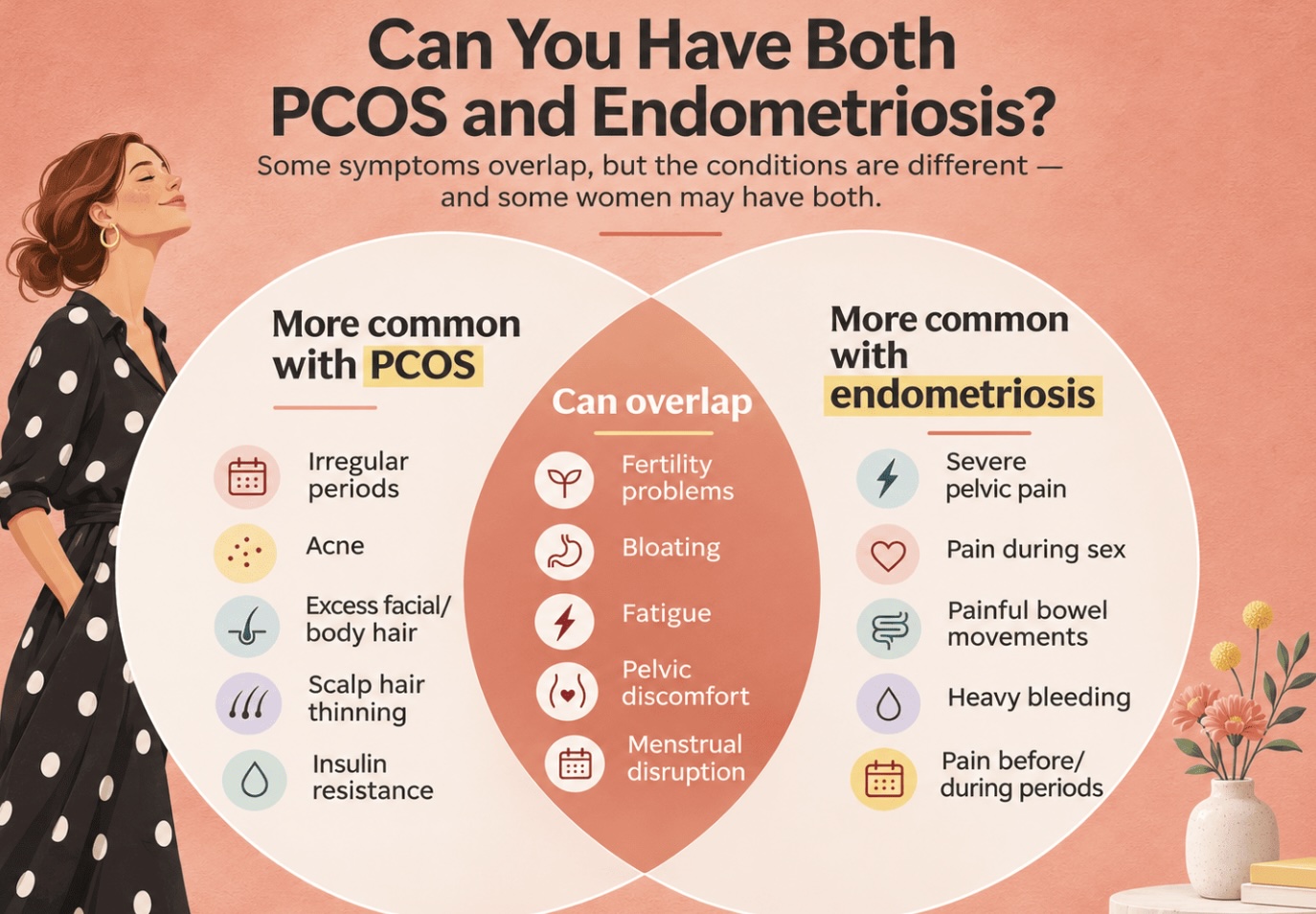
Yes. They are distinct conditions, but one diagnosis does not protect against the other. Fertility difficulties, fatigue and menstrual concerns can overlap, while pain patterns and androgen-related symptoms may provide more specific clues. No general internet percentage can reliably predict an individual’s chance of having both.
Imagine someone diagnosed with PCOS because of irregular cycles and acne. Later, she develops worsening period pain and bowel pain around menstruation. Those new symptoms deserve a separate assessment, rather than automatically being attributed to PCOS. The reverse applies when someone with endometriosis develops increasingly irregular cycles and signs of androgen excess.
A simple symptom timeline can make appointments more productive. Record the dates of periods, the location and timing of pain, bowel and bladder symptoms, skin or hair changes, current medicines and fertility plans. It is more useful than attempting to choose a diagnosis from an online symptom list.
How Treatment and Nutrition Support Differ
Managing PCOS involves reproductive and metabolic goals
PCOS treatment may include lifestyle guidance, management of irregular periods or androgen-related symptoms, and checks on metabolic risk. When pregnancy is desired, clinicians may discuss appropriate fertility assessment and ovulation-induction treatments. One person’s PCOS plan should not be reduced to weight loss alone.
The international PCOS guideline recommends healthy lifestyle support throughout life, while finding no evidence that any one dietary composition is superior across relevant PCOS outcomes. Food plans should be nutritionally adequate, flexible and adapted to health needs, preferences and practical routines.
Endometriosis treatment focuses on pain, functioning and priorities
For endometriosis, treatment may include pain relief, hormonal medication, specialist referral or surgery in selected cases. Decisions depend on symptoms, treatment history, personal preferences and whether pregnancy is being pursued. The European Society of Human Reproduction and Embryology guideline emphasises shared decisions about benefits and drawbacks.
No dietary cure for endometriosis has been established. Current specialist guidance does not recommend a particular nutrition intervention as a proven treatment for endometriosis pain or infertility. A nourishing and flexible diet may support general wellbeing, but should not replace medical assessment and treatment.
Where a nutrition professional can be useful
Nutrition is not a way to diagnose the source of pelvic pain. Its value becomes clearer when the condition and individual needs are understood. With PCOS, a plan may consider meal regularity, adequate protein and fibre, blood sugar, cardiovascular risk and strategies that do not impose unnecessary food rules.
If you are managing PCOS and struggling to turn general dietary advice into a workable routine, a qualified PCOS nutritionist can help you explore personalised nutrition choices and sustainable habits. Nutrition support does not replace gynaecological assessment, hormone treatment or fertility care.
With endometriosis, be cautious of promises that removing gluten, dairy or entire food groups will cure the condition. The evidence does not support a universal endometriosis diet, and unnecessary restriction can make eating harder.
Living With Symptoms During a Busy Working Week
When pain, fatigue or unpredictable bleeding clash with deadlines, childcare and meetings, a few practical steps may help while appropriate medical care is arranged:
· Keep a brief symptom record with period dates, pain timing, digestive changes and missed activities. The goal is a useful summary for your clinician, not constant self-monitoring.
· Ask which symptoms require prompt assessment and whether a GP, gynaecologist or another specialist should be involved.
· Plan reasonable flexibility for appointments or symptom flares where your circumstances allow, without feeling obliged to share more medical detail at work than you wish.
· Keep manageable meals and hydration available on busy days. Flexible routines are generally more sustainable than trying to follow a perfect food plan.
· Do not assume severe period pain is simply something to endure. Talented Ladies Club also offers suggestions for working during your period.
Seek urgent care for sudden severe pelvic pain, fainting, very heavy bleeding or other alarming new symptoms. A significant change deserves assessment even if you already have a PCOS or endometriosis diagnosis.
Frequently Asked Questions
Is PCOS the same as endometriosis?
No. PCOS mainly involves ovulation, androgen signalling and metabolic health. Endometriosis involves endometrial-like tissue outside the womb. Their symptoms can overlap, but they are different conditions.
Can PCOS turn into endometriosis?
There is no evidence that PCOS transforms into endometriosis. A person can have both, but they remain distinct diagnoses.
Is endometriosis pain worse than PCOS pain?
There is no reliable universal pain ranking. Significant cyclical pelvic pain is more characteristic of endometriosis, but pain has many potential causes and varies among individuals.
Does a normal ultrasound rule out PCOS or endometriosis?
No. A normal ultrasound does not exclude endometriosis. PCOS can also be diagnosed without characteristic ovarian ultrasound findings when the other accepted adult criteria are met.
Can you have both PCOS and endometriosis?
Yes. If symptoms change or are not explained by an established diagnosis, further assessment may be necessary.
Does diet treat PCOS and endometriosis the same way?
No. Healthy eating is part of recommended PCOS metabolic-health care, but no single PCOS diet has demonstrated superiority. Specialist endometriosis guidelines have not established one dietary treatment for the disease itself.
The Bottom Line
PCOS vs endometriosis is not a choice between two labels for difficult periods. One condition strongly affects ovulation and metabolic health; the other often presents through pelvic pain and inflammation. Their symptoms overlap, they can coexist, and neither should be self-diagnosed from a chart.
The most useful next step is to explain your complete symptom pattern, ask which investigations are appropriate, and seek care tailored to your health and priorities. The right explanation can help you spend less time second-guessing symptoms and more time finding support that works.
References
- World Health Organization. Polycystic ovary syndrome. Fact sheet, January 2026.
- World Health Organization. Endometriosis. Fact sheet, October 2025.
- International Evidence-based Guideline for the Assessment and Management of PCOS, 2023.
- National Institute for Health and Care Excellence. Endometriosis: diagnosis and management (NG73), updated recommendations.
- European Society of Human Reproduction and Embryology. ESHRE guideline: endometriosis, 2022.
- Teede HJ et al. Polyendocrine metabolic ovarian syndrome, the new name for polycystic ovary syndrome: a multistep global consensus process. The Lancet, 2026.