Five software solutions for HIPAA compliance management

Healthcare organizations are juggling federal rules, state regulations, and payer requirements all at once, and the margin for error keeps shrinking. Tracking HIPAA compliance across spreadsheets and email threads is slow, and it creates real liability. The right software for HIPAA compliance management brings policy tracking, risk assessment, vendor oversight, and incident reporting into one auditable system, replacing guesswork with documented, repeatable processes.
Why HIPAA compliance software matters for healthcare organizations
A HIPAA violation can cost a covered entity anywhere from $137 to $2.1 million per violation category, according to the U.S. Department of Health & Human Services Office for Civil Rights schedule. But fines are only part of the picture. OCR audits, ransomware incidents, and business associate breaches all demand that compliance teams produce documented evidence fast, a risk register, an audit trail, a breach-risk assessment. Organizations still managing those records across disconnected tools consistently struggle to pull that evidence together under deadline pressure.
Purpose-built compliance platforms address this by centralizing every required record. They automate the routine work, policy acknowledgment reminders, vendor assessment follow-ups, corrective action tracking, so compliance staff can focus on issues that actually require judgment. And for multi-facility health systems or MSPs supporting multiple healthcare clients, a shared platform means consistent processes across every site rather than a patchwork of local approaches.
1. ComplyAssistant
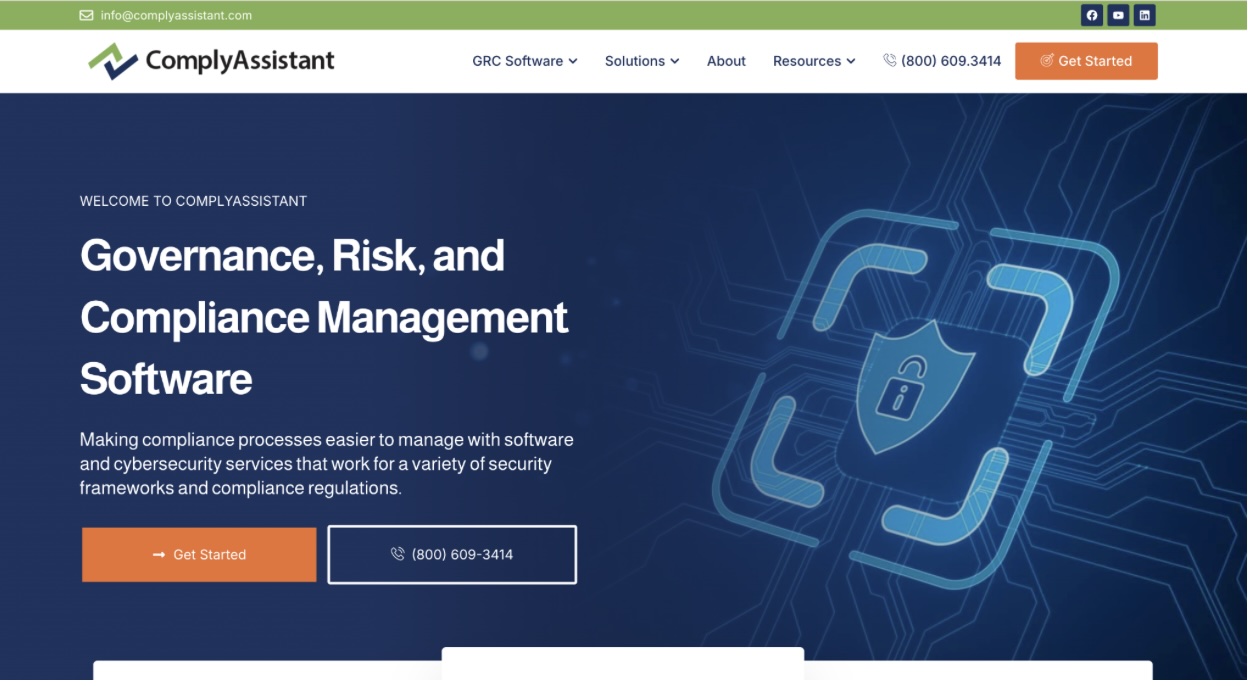
ComplyAssistant is a healthcare-specific governance, risk, and compliance platform founded in 2002 and based in Colts Neck, New Jersey. Unlike broader enterprise GRC tools that get adapted for healthcare after the fact, it was built from the ground up around hospital and health system workflows. The platform covers HIPAA, HITRUST, NIST, PCI, ISO 27001, SOC 2, FFIEC, and more than a dozen additional frameworks in one system, so a multi-state organization isn’t running a separate tool for each regulation.
Main modules include policy and document management with version control and digital-signature attestation, a six-step risk register for scoring and tracking threats to PHI, audit management with regulatory-aligned templates, vendor risk management with automatic PHI-based tiering, and incident reporting with a built-in HIPAA breach-risk assessment questionnaire developed with attorney input. A mobile audit app lets compliance staff complete facility walkthroughs on a phone or tablet, with photos, preloaded issue picklists, and encrypted sync back to the platform, which replaces paper checklists that would otherwise need to be re-entered manually.
The platform also supports a white-label program for MSPs and MSSPs, with three distinct client-access tiers and sub-account structures for managing multiple healthcare clients from one place. ComplyAssistant pairs its software with delivered consulting services: security risk assessments, HIPAA-HITECH audits, virtual CISO engagements, and disaster recovery planning, all logged directly into the same platform the client uses day to day. Named clients include Cape Regional Health System, AtlantiCare Healthcare, Inspira Health Network, and Metro Health University of Michigan. Pricing is quote-based; engagements start with a demo.
2. MetricStream
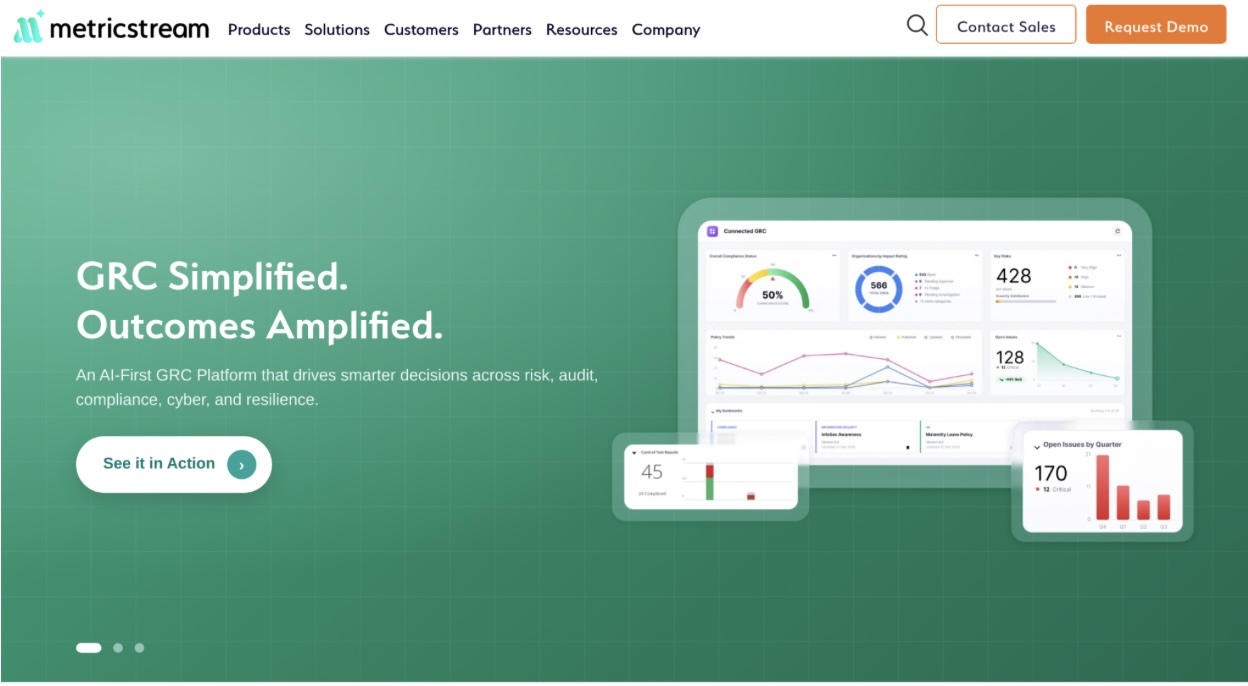
MetricStream is a GRC software platform founded in 1999 and headquartered in San Jose, California, with an R&D center in Bangalore and a global sales network. The platform serves over one million GRC professionals across 35 or more countries, with clients spanning banking, healthcare, insurance, energy, life sciences, and utilities. Named customers include Shell, Fitch Ratings, Siemens Energy, and Zurich Insurance.
The product line covers compliance management, internal audit, SOX compliance, cyber GRC, and third-party risk management, all delivered on a low-code/no-code cloud platform. MetricStream uses AI to automate repetitive GRC tasks; the company estimates that its AI-first capabilities can eliminate 80 to 90 percent of routine task volume. For healthcare organizations managing HIPAA and related compliance requirements alongside broader enterprise risk programs, that kind of automation can meaningfully cut the manual workload on compliance teams.
MetricStream was ranked a Leader across all five assessed domains in Chartis Research’s Governance, Resilience, and Compliance Solutions 2025 report, covering enterprise GRC, GRC analytics, regulatory intelligence, third-party risk, and audit risk. It also earned recognition in the Verdantix Green Quadrant: GRC Software 2025 report and placed first in operational risk and audit categories in the Chartis RiskTech AI 50 2025 ranking. The company has raised $351 million in funding. Pricing details aren’t publicly available; buyers contact MetricStream directly for a quote.
3. HealthStream
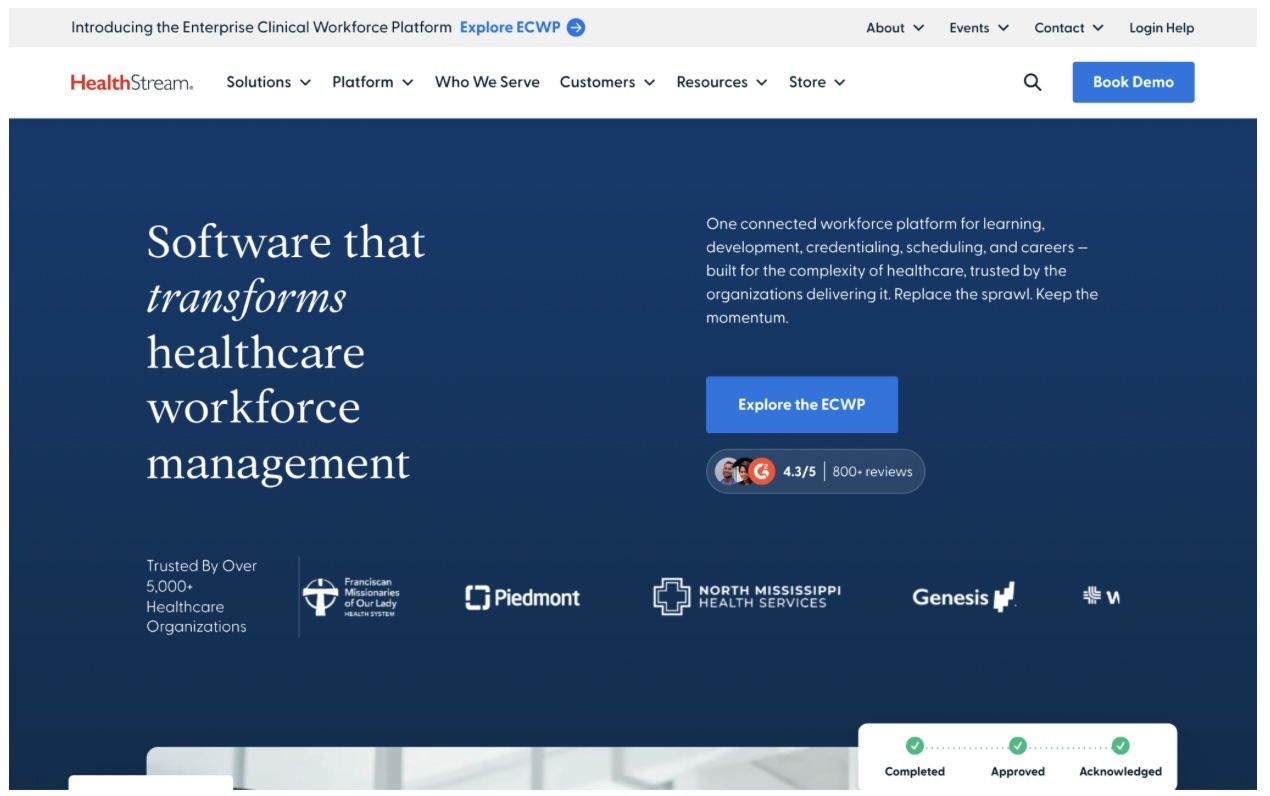
HealthStream is a Nashville, Tennessee-based SaaS company incorporated in 1990, focused on workforce development, training, credentialing, and performance assessment for healthcare organizations. It works with more than 4,000 healthcare organizations nationwide, including more than 70 percent of all U.S. hospital and healthcare systems, and counts more than 4.5 million active platform subscribers.
The platform’s two main segments are Workforce Solutions and Provider Solutions. Workforce Solutions handles learning management, compliance training, and simulation-based education; Provider Solutions manages provider credentialing, privileging, call-center workflows, and enrollment. For HIPAA-related compliance, the learning and policy management tools are the entry point: organizations use them to assign and track required training, document staff attestations, and generate audit-ready completion reports. HealthStream’s SafetyQ and ComplyQ products sit within this space.
In 2026, HealthStream was named to G2’s Best Healthcare Software list, earning more Top 50 placements than any other vendor on the list, with its Learning Center, SafetyQ/ComplyQ, and Jane tools each recognized. The company has received over 30 Brandon Hall Excellence in Technology Awards and holds multiple technology patents, including patents on its Jane and CredentialStream tools. Revenue for the trailing 12 months through September 2025 was $299 million. Pricing isn’t listed publicly on the HealthStream website.
4. First Healthcare Compliance

First Healthcare Compliance was founded in 2012 in Wilmington, Delaware, by Julie Sheppard to address the lack of accessible compliance resources for physicians and smaller healthcare providers. In August 2022, it became a division of Panacea Healthcare Solutions. The company serves private practices, hospital networks, health systems, healthcare billing companies, and skilled nursing facilities, with a particular focus on organizations that don’t have large in-house compliance departments.
The platform covers HIPAA, OSHA, human resources compliance, and fraud, waste, and abuse regulations. Features include an anonymous hotline, URL-based incident reporting, document management with online distribution and attestation, LEIE database checks, real-time regulatory updates, audit logs with date and time stamps, and an online sample documents library. Pricing is subscription-based, tiered by number of employees, with three plan options; specific rates are available on request via phone, email, or online help desk.
Case studies document clients including an orthopedic and sports physiotherapy practice in the Mid-Atlantic, a pediatric care practice, a 25-bed hospital with limited resources, and a West Coast healthcare management system that mandates compliance for all its clients as a condition of the business relationship. First Healthcare Compliance is a privately owned women’s business enterprise with 11 to 50 employees.
5. SAI360

SAI360 is a Chicago-based cloud and AI-driven GRC and environmental, social, and governance (ESG) software provider with roughly 438 employees. The company has over 25 years of experience helping organizations manage risk, and its platform brings compliance management, regulatory change tracking, audit management, business continuity, ethics training, and policy management under one roof. It was acquired by STG.
The SAI360 GRC Platform is built to manage multiple risk types at once while supporting a risk-aware compliance program. Healthcare organizations use it alongside clients in financial services, energy, utilities, and manufacturing. The platform’s AI tools connect ethics, risk, and compliance data so teams can surface issues earlier; its flexibility lets users customize workflows and frameworks to match their specific regulatory environment. Clients include Colgate-Palmolive, Panasonic Energy, ABB, Stewart Title, Kraft Heinz, and the North American Electric Reliability Corporation, which manages compliance for more than 6,000 named accounts across three countries.
So where does pricing land? Subscription-based across three editions, Essentials, Professional, and Enterprise, it scales with organization size, modules selected, and deployment scope. External analysis places starting prices somewhere in the $500 to $1,000 range, though SAI360 doesn’t publish rates publicly and requires a demo and quote for firm numbers. The company earned recognition in the Verdantix Green Quadrant for GRC Software 2025, won Company of the Year in the Educational Technology category at the 2025 Stevie Awards for Technology Excellence, and received six Brandon Hall Learning and Development awards, including three gold awards.
Capabilities to evaluate in compliance management platforms
Not every platform covers the same ground. Before choosing among software for HIPAA compliance management, compliance teams should confirm which of the following capabilities the platform actually delivers versus what it lists as an add-on or separate module.
Risk assessment and risk register functionality is non-negotiable for HIPAA compliance. The Security Rule requires a documented, organization-wide risk analysis. Platforms vary widely here: some offer a structured scoring workflow with remediation task assignment; others provide a simple spreadsheet-style log with no automation.
Vendor and business associate management is another area where gaps show up quickly. Every covered entity must track active BAAs, assess vendor PHI access levels, and document that assessments occurred. Look for automatic risk tiering by PHI exposure and BAA renewal tracking rather than a flat vendor list with no alerting.
Incident reporting with breach-risk assessment logic is worth scrutinizing closely. HIPAA’s breach notification rules require a four-factor risk assessment on every incident before a covered entity can determine whether notification is required. Platforms that walk users through that assessment within the incident record, rather than directing them to a separate process, reduce the chance of a missed step.
And for organizations with multiple sites or remote staff, a mobile audit capability matters more than it might seem. On-site walkthroughs, equipment checks, and physical safeguard audits are all HIPAA requirements that paper checklists handle poorly at scale.
Bottom Line
Software for HIPAA compliance management ranges from healthcare-purpose-built platforms with deep HIPAA-specific workflows to broad enterprise GRC tools that treat healthcare as one vertical among many. The right fit depends on organization type, in-house compliance experience, the number of frameworks in play, and whether a team needs delivered consulting alongside the software or a self-serve tool they can configure on their own. Smaller practices and those newer to formal compliance programs may find more value in platforms designed for their scale; large health systems and MSPs supporting multiple clients typically need more flexible multi-entity architecture and deeper risk management capabilities.