Choosing help for an Extraordinary Ability Visa: Six firms compared

So you’ve decided to go for a visa built for people at the top of their field. Exciting, right? Then you start searching for help and realise there are dozens of firms, and they all claim to be the best.
This guide makes that choice easier. We’ll walk through what actually matters when you compare firms, then look at six well-known options side by side. It’s general information, not legal advice, and every case is different.
Why the firm you choose matters
This isn’t a fill-in-the-form kind of application. You have to prove that you stand out, and the way your achievements are presented can shape the outcome.
A good firm helps you spot your strongest evidence, find the gaps early and tell your story clearly. A poor fit can leave you with a thin petition, a request for more evidence, or a denial that costs you time and money. Just as with any unexpected legal problem in your career, it pays to find a true specialist you’ll feel comfortable working with for months.
What to compare before you pick
Before looking at specific firms, it helps to know what you’re measuring them against.
Experience with your kind of case
A biotech researcher and a fashion designer need very different evidence. Ask whether the firm regularly handles cases like yours, not just these visas in general.
How the work gets done
Some firms give you a small, hands-on team. Others use large teams, technical writers or tech platforms with tracking dashboards. Neither is better by default. It depends on how much contact and visibility you want.
How fees are set
Some firms publish flat fees online. Others quote each case after a consultation. Either way, get a written quote that spells out what’s included.
What happens if USCIS asks for more
Requests for evidence are common. Ask whether responding to one is included in your fee or billed separately.
Support beyond the first approval
Many people on these visas later apply for an extension or a green card. A firm that can guide those next steps saves you from starting over with someone new, and it already knows your story.
| What to compare | Why it matters | What to ask |
| Case experience | Evidence differs by field | Have you handled cases like mine? |
| Working style | Affects contact and speed | Who will work on my case day to day? |
| Fees | Avoids surprise costs | Is your fee flat, and what does it cover? |
| Evidence requests | Common and time-sensitive | Is a response included in the fee? |
| Long-term plans | Many people later seek a green card | Can you help with the next step too? |
Six firms side by side
Here’s how six firms describe their services. Fees and details were checked on each firm’s website in November 2026 and may change.
1. Lightman Law Firm: Full-service support with a personal approach

Lightman Law Firm helps clients in the sciences, business, education, athletics and the arts, with offices in New York, New Jersey and Virginia.
What stands out: Its service covers strategy sessions, a persuasive attorney support letter, recommendation letters, evidence gathering, government forms and responses to requests for evidence. It says it avoids one-size-fits-all templates.
Fees: Its page notes that established firms typically charge USD 5,000 and up for this work.
Worth asking: How your case strategy will be tailored to your field.
2. Colombo & Hurd: Data-driven strategy from a large team

Colombo & Hurd has more than 20 years in immigration law and over 350 team members across the US, Latin America and beyond.
What stands out: A former 13-year US immigration officer is on its team, and it uses a proprietary case management system to share updates. It also offers an online eligibility questionnaire.
Fees: Not listed on its visa page, so ask for a quote.
Worth asking: Who will handle your case day to day within such a large team.
3. Berardi Immigration Law: Broad experience across many fields

Berardi Immigration Law says it has handled hundreds of these petitions, with offices in the US, Canada and the UK.
What stands out: Its experience spans business, entertainment, social media, sports, science and medicine, from executives to dancers and physicians. Its guidance also flags that film and TV applicants need advisory opinions from both a union and a management group.
Fees: Not listed on its visa page, so ask for a quote.
Worth asking: Which of its past cases look most like yours.
4. Manifest Law: Published flat fees and payment plans
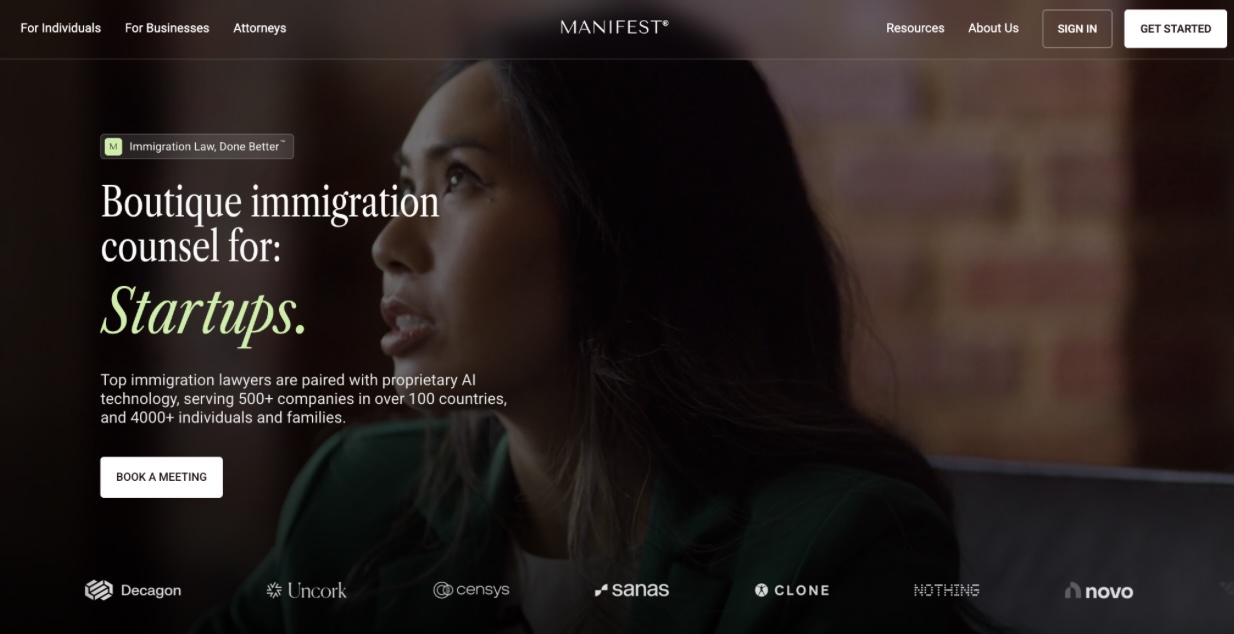
Manifest Law is a flat-fee firm that works with founders and other professionals nationwide.
What stands out: Its fees start at USD 6,999, with payment plans of up to six months. Money-back guarantees apply on certain plans, subject to terms. Every case gets a second legal review, and clients can track preparation through an online portal.
Fees: From USD 6,999, with the final quote set on a strategy call.
Worth asking: Which plan includes responses to requests for evidence.
5. Alma: Tech-enabled service with set timelines

Alma pairs immigration attorneys with a technology platform and offers a free consultation.
What stands out: It promises a two-week case preparation turnaround once your evidence is complete, with two layers of human review on every document. It works with both individuals and businesses, covering temporary work visas and employment green cards.
Fees: From USD 8,000 for a new petition, which covers responses to requests for evidence.
Worth asking: How much direct time you’ll get with your lead attorney.
6. Klasko Immigration Law Partners: Specialist writers for research cases

Klasko Immigration Law Partners is based in Philadelphia and has a dedicated team for extraordinary ability and national interest cases.
What stands out: That team is supported by technical writers trained for these petitions, and the firm publishes regular analysis of denial trends. It also has a team for athletes and entertainers.
Fees: Not listed on its visa page, so ask for a quote.
Worth asking: How its writers and attorneys split the work on your case.
Red flags to watch for
Most firms are professional and honest, but a few warning signs are worth knowing.
Promises of guaranteed approval
Only USCIS decides your case. A firm that promises approval is overselling, however confident it sounds.
Vague answers about fees
If a firm can’t explain what’s included, or keeps adding costs later, budgeting becomes a guessing game.
No clear owner for your case
You should know who is responsible for your strategy and final review. If nobody can tell you, ask again before signing.
How to choose the right fit for you
There’s no single winner here. The best firm is the one that matches your field, your budget and the way you like to work.
If you want a personal, hands-on approach
Look for a firm that tailors its strategy to you, drafts your key letters and stays with you if USCIS asks for more evidence.
If budget certainty matters most
Firms with published flat fees make planning easier. Just check what each plan includes before you sign.
If you like tracking everything online
Tech-enabled firms with portals and set timelines suit people who want constant visibility.
If your work is highly technical
A firm with dedicated writers or deep research experience may explain complex achievements more clearly.
Whichever way you lean, book consultations with two or three firms. Compare how well each one understands your work, not just its price. Notice how clearly they explain things, too. A confusing first call tells you something.
Conclusion
Choosing a firm for this kind of visa is a bit like hiring someone to tell your career story to a very strict audience. You want someone who understands your field, explains things clearly and is upfront about fees.
Use the checklist in this guide, ask the same questions at every consultation and go with the firm that leaves you feeling most confident. A little extra time spent choosing now can save you months later.
FAQs
How many firms should I speak to before deciding?
Two or three is usually enough. It gives you a fair comparison without leaving you overwhelmed by options.
Is a flat fee always better than a custom quote?
Not always. A flat fee is easier to budget for, but a custom quote may better reflect a complex case. What matters most is knowing exactly what’s covered.
Can any firm guarantee approval?
No. USCIS makes the final decision. Some firms offer money-back terms, but that’s a refund policy, not a promise of approval.
Do I need a firm near where I live?
Not necessarily. Many firms work with clients remotely across the country and abroad, so focus on experience and fit rather than location.