
Complying with global lobbying laws: A comprehensive guide

Table of contents
- Understanding Global Lobbying Laws
- Key Challenges in Compliance
- Best Practices for Global Lobbying Compliance
- Case Study: The Foreign Agents Registration Act (FARA)
- Recent Developments in Lobbying Transparency
- Conclusion
In a world where companies and organizations operate across national borders, compliance with multifaceted lobbying laws is more critical—and complex—than ever before. Every jurisdiction features its own set of rules and regulations, which means a one-size-fits-all approach is rarely practical.
Whether you’re an NGO, multinational corporation, or professional association, understanding global lobbying standards and maintaining transparent practices is crucial for both legal compliance and maintaining a strong organizational reputation. Organizations seeking in-depth guidance often find it valuable to utilize specialized resources like International Lobbying Compliance to help navigate these regulations.
Global lobbying law compliance extends far beyond basic registration or disclosure. It intertwines with anti-corruption statutes, economic sanctions, and emerging governmental expectations for transparency. From high-profile legislative changes to shifting international norms, even seasoned compliance professionals must remain vigilant as the landscape continues to evolve rapidly. Ignoring jurisdictional nuances, meanwhile, can expose organizations to significant penalties and reputational damage.
Effective lobbying compliance isn’t simply about ticking the right boxes; it’s about integrating legal frameworks, ethical considerations, and real-world best practices into a seamless operational strategy. For any organization involved in influencing public policy, robust compliance structures are an indispensable foundation for sustainable growth and global credibility.
Equally important is ongoing awareness of how prominent global and regional regulators interpret and enforce lobbying requirements. Staying informed helps organizations adapt proactively and avoid unintentional violations.
Understanding global lobbying laws
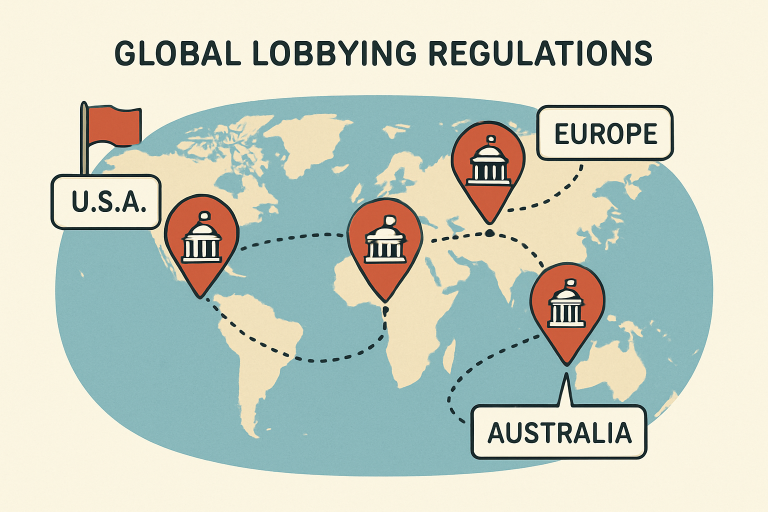
Lobbying regulations differ vastly across continents and even between neighboring countries. The Foreign Agents Registration Act (FARA) in the United States, for example, imposes stringent registration and reporting requirements on any agent representing foreign interests.
The law’s scope casts a wide net—requiring disclosures surrounding funding, contacts, and any attempt to influence government actions. In Canada and Australia, federal frameworks coexist with additional obligations at the provincial and state levels, sometimes imposing conflicting requirements and requiring further attention from compliance teams.
In the European Union, lobbying rules are increasingly harmonized, particularly in light of recent calls for greater oversight of third-country influence on policy decisions. The EU Transparency Register, for instance, is designed as a public database cataloging organizations and individuals seeking to influence EU institutions. Transparency is a unifying theme, but the details—what triggers registration, what must be disclosed, and how often—can vary not just globally, but also within national or regional borders.
Key challenges in compliance
- Jurisdictional Variations: The distinct rules of every jurisdiction make it complicated to develop universal compliance strategies. Some countries may require detailed financial reporting, while others emphasize organizational relationships and intent.
- Frequent Legislative Changes: Lobbying laws are in a state of constant flux. Regulatory bodies periodically revise definitions of “lobbying” or “foreign agent,” introduce new forms and timelines, and increase enforcement as political climates shift.
- Disclosure Requirements: Required disclosures range from client rosters to expenditure reports, which are sometimes provided on a monthly or quarterly basis. For multinational organizations, this creates a significant paperwork and administrative burden.
Best practices for global lobbying compliance
- Develop a Comprehensive Compliance Program: Tailor policies and protocols to address the unique needs of each relevant jurisdiction, recognizing that lobbying thresholds and definitions may differ country-by-country.
- Regular Training and Education: Ensure every employee, board member, and consultant understands what constitutes lobbying in every applicable market. Consider regular, mandatory legal updates and scenario-based learning.
- Implement Robust Record-Keeping: Maintain meticulous records that track all contacts, meetings, filings, and expenditures to facilitate compliance during audits and respond to regulatory inquiries.
- Engage Legal Experts: Retain local counsel or international law firms with lobbying expertise to guide the organization through complex, evolving requirements. This is particularly essential for cross-border activities and interactions with foreign governments.
Case study: The Foreign Agents Registration Act (FARA)
Enforced by the U.S. Department of Justice since 1938, FARA is among the oldest and strictest lobbying statutes worldwide. Organizations or individuals acting at the behest of foreign principals must register and file periodic, detailed reports outlining their lobbying activities, compensation arrangements, informational materials, and contacts with policymakers.
Recent years have brought renewed scrutiny and enforcement under FARA, with the Department of Justice prioritizing cases involving high-profile foreign influence and politically sensitive issues. As such, multinational organizations engaging with the U.S. government must pay special attention to FARA’s expansive reach and severe penalties for non-compliance.
Recent developments in lobbying transparency
Transparency has become the cornerstone of effective lobbying regulation worldwide. The European Parliament, for instance, has implemented stricter disclosure and registration requirements in response to heightened scrutiny of external influence. These initiatives align with broader global trends toward mandatory lobbying registers, real-time disclosure of meetings, and stricter conflict-of-interest provisions.
Many Asian jurisdictions, including South Korea and Japan, are considering updates to their lobbying statutes to align with international expectations for ethical influence and transparency in government. Regulatory developments are often well-publicized, as governments seek to reassure their constituents that policy is being shaped in the public interest rather than by undisclosed actors.
Proactive compliance is essential
Complying with global lobbying laws requires a sophisticated, adaptive approach. By understanding jurisdiction-specific requirements, prioritizing continuous education, and embracing transparency as a guiding principle, organizations can successfully manage the multifaceted risks of international lobbying.
Proactive compliance not only mitigates legal and reputational risks but also strengthens stakeholder trust—an essential asset in today’s interconnected and highly scrutinized global marketplace.


