Claddagh rings for mothers and daughters: Passing down an Irish tradition

Some of the most precious things we own aren’t expensive. They’re the things that were given to us by someone who loved us, and that we plan to give to someone we love in turn. In Ireland, few objects carry that kind of meaning quite like the Claddagh ring.
For generations, Claddagh rings have been passed from mothers to daughters, and from grandmothers to granddaughters. Today, women all over the world are keeping that tradition alive, or starting it fresh in their own families. Here’s why the Claddagh is such a fitting ring to pass down, and how to make the tradition your own.
A Ring That Says What Matters
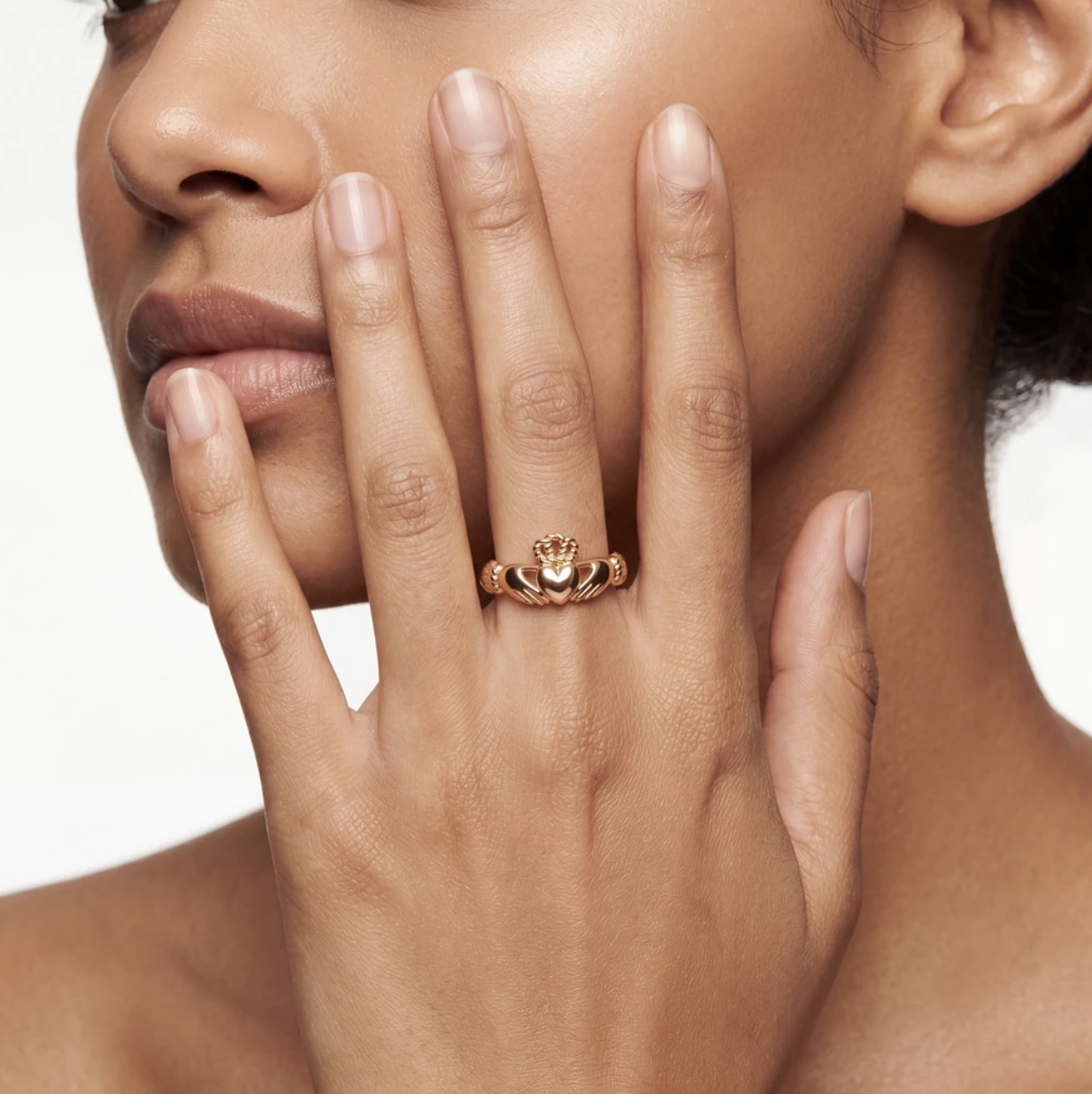
The Claddagh ring comes from the Claddagh, a fishing village just outside Galway City on the west coast of Ireland. Its design is made up of three symbols:
- Two hands for friendship
- A heart for love
- A crown for loyalty
Those three words sum up the best of the relationship between a mother and her daughter. Love, of course. Loyalty, through every stage of life. And, as daughters grow up, a friendship that often becomes one of the most important of their lives.
That’s why, in the west of Ireland, a Claddagh was traditionally handed from mother to daughter. Often it was a family’s most valuable piece of jewellery, and it carried the stories of every woman who had worn it before.
When to Give a Claddagh Ring
There’s no single right moment, but a few milestones have become popular in Irish families and beyond.
Confirmation or a first communion. For many Irish Catholic families, this is a traditional time to give a first piece of “real” jewellery, and a small sterling silver Claddagh is a classic choice.
An 18th or 21st birthday. A Claddagh marks the move into adult life, with a message about the kind of relationships worth building.
Graduation or a first job. For a daughter heading out into the world, a Claddagh is a small, everyday reminder of home.
Leaving home or moving abroad. Generations of Irish emigrants carried Claddagh rings with them. Giving one to a daughter who is moving away keeps that tradition, and that connection, alive.
Her wedding day. A family Claddagh makes a meaningful “something old”. Some brides wear it on the right hand and have it moved to the left, with the heart turned inwards, during the ceremony.
Becoming a mother herself. Passing your own Claddagh to your daughter when she has a child of her own is a beautiful way to mark a new generation.
The Language of the Ring
Part of the fun of giving a Claddagh to a daughter is teaching her how to wear it. Tradition says the ring’s position tells the world where your heart is:
• Right hand, heart pointing out: single
• Right hand, heart pointing in: in a relationship
• Left hand, heart pointing out: engaged
• Left hand, heart pointing in: married
Many women can remember their mothers explaining this to them, and the moment they first turned the ring around. It’s a small family ritual that’s easy to pass on.
Starting Your Own Tradition
You don’t need a ring that’s been in the family for 100 years to begin. Every heirloom was new once. If you’d like to start a Claddagh tradition, here are a few ideas.
Matching rings
Some mothers and daughters choose matching Claddagh rings, perhaps a gold one for mum and a silver one for her daughter. It’s a lovely way to share the tradition while you’re both wearing it.
Birthstones
A Claddagh with a birthstone set into the heart is a popular choice for mothers. Some women choose a ring with one stone for each of their children, or add a daughter’s birthstone to a ring they plan to pass on.
Engraving
An engraving inside the band turns a ring into a family record. Names, dates or a short phrase in Irish all work well. “Mo chroí” means “my heart”, and “Grá go deo” means “love forever”.
Choosing the metal
• Sterling silver is affordable and perfect for a younger daughter’s first Claddagh.
• Yellow gold is the most traditional and the most likely to last for generations.
• White and rose gold feel a little more modern while keeping the same classic design.
If the ring is meant to become an heirloom, it’s worth choosing solid gold and looking closely at the craftsmanship: well-defined fingers, a crisp crown and a heart that sits centrally.
Browsing a specialist collection of Claddagh Rings side by side, in different metals and with different stones, can make it much easier to choose a ring for each generation.
Keeping the Story Alive
An heirloom is only as meaningful as the story that comes with it. When you give a Claddagh ring to your daughter, tell her why you chose it, when you first wore your own, and who in your family wore one before you.
If your family has Irish roots, you might also share a little of where the ring comes from. Galway’s Claddagh village, its fishing families and its customs are part of a much bigger Irish story, and Ireland.com, Tourism Ireland’s official site, is a lovely starting point if you’d like to plan a trip to see it together one day.
More Than a Ring
Jewellery trends come and go, but the Claddagh has stayed the same for more than 300 years. Its message of love, friendship and loyalty is exactly what so many of us hope to pass on to our daughters.
Whether you’re handing down a ring that has been in your family for generations, or buying the very first one, you’re giving more than a piece of jewellery. You’re giving a story, and inviting her to carry it forward.